

 Apple Podcasts
The 229 Podcast · 55 min listen
40:00
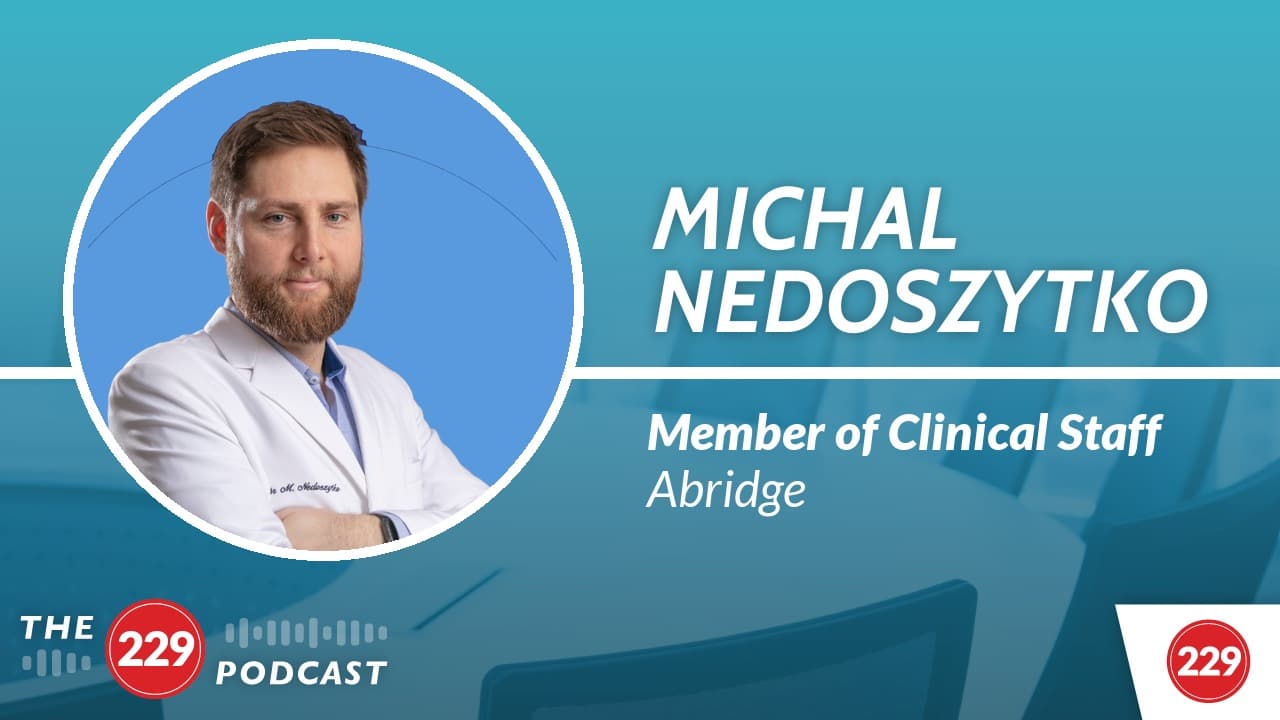
with Michal Nedoszytko
October 8, 2026: Michal Nedoszytko, Member of Clinical Staff at Abridge, sits down with Bill Russell. He is a cardiologist. He practiced in Belgium and Poland for 17 years. As an intern he was making 50 lab sheets a day. He says a PDF generator took that from 25 minutes to about 2 minutes, and the cardiology department started using it. In 2013 the Ministry of Health in Poland required reimbursement amounts on paper prescriptions, from a spreadsheet of about 15,000 medications. He built a site for that. He says about 100,000 doctors a month still use it, almost 15 years later. He says 13,000 people applied to an Anthropic hackathon and he finished third with a post-visit tool he built between patients. He says Abridge shipped real-time voice chart pull about a month before this recording, and he credits Eric Topol with the term Keyboard Liberation. He says the clerical work should leave the visit, and the decision stays with the patient and the doctor.
Key Points:
0:00 Doctors who build
2:31 50 sheets a day
5:57 Between the STEMIs
7:33 15,000 medications
9:54 Still used, almost 15 years later
13:31 One hackathon, 13,000 applications
29:36 Keyboard Liberation
32:49 The patient and the note
35:35 The clerical work leaves the visit
37:29 The decision stays human
Donate: Alex's Lemonade Stand: Foundation for Childhood Cancer
This transcription is provided by artificial intelligence. We believe in technology but understand that even the smartest robots can sometimes get speech recognition wrong.
The Clerical Work Should Leave the Visit | The 229 Podcast with Michal Nedoszytko
[00:00:06] Bill: All right, it's the 229 Podcast, and I'm Bill Russell, joined today Michael, I'm gonna have you introduce yourself. I'm gonna give you a little of your bio, but I'll have you introduce yourself and your role at a bridge.
[00:00:20] Michal: Hello, Bill, and thank you very much. It's such a privilege to be here today with you. So, my name is Michal Nedosydko. I'm a cardiologist. I've been practicing in Belgium and in Poland for the past 17 years. And this year, after a certain event that happened in San Francisco in February, I…
[00:00:40] Michal: joined the bridge. My role initially was called Clinician Scientist. Recently, we did a bit of rebranding. Right now, it's called Member of Clinical Staff. which translates to doctor.codes.
[00:00:55] Bill: Interesting. Cool. Well, we're gonna, we're gonna follow your, we're gonna follow your journey, because I think this is a great… It's a great example of when doctors become builders, when doctors really dig in and say, I'm going to solve this problem, especially with a
[00:01:12] Bill: technical background. So I found your profile from 2014, and around that time, you were already building software because you were tired of copying the same information into the medical record.
[00:01:26] Bill: More than a decade later, you're now helping build clinical AI at a bridge. Take me back, though, to your first frustration. What happened in your workday that made you just decide that, hey, I'm going to build something and I'm going to build it myself?
[00:01:43] Michal: Well, I've been coding since the age of, I believe, 14 or 15, since ever I got my first computer, so it was way before med school. But if I would have to recall this first moment that.
[00:01:57] Michal: that initiated as a clinical frustration that translated into real clinical code, I would say that it was just after my graduation. So, in Poland, after 6 years of med school, you spend a year as. as a well, you wouldn't call it yet resident. It's called post-graduation internship.
[00:02:17] Michal: And I remember that I was doing a lot of paperwork. It was mostly demands for bio lab works. And, you know, there was stamps involved and I needed to create like 50 sheets every day.
[00:02:33] Michal: So what I did, I created a PDF generator, which also kind of helped me to generate those virtual stamps back at the time, so instead of spending 25 minutes on it every day, I just printed it out in a matter of, let's say, 2 minutes. And then the whole department started using it, and then we introduced
[00:02:51] Michal: well, the patients, then we introduced the discharge letter, summaries, anamnesis, and so on, and it turned out to become a full-blown electronic health record. So, that was, I would say, my first frustration.
[00:03:05] Bill: Wow. So that was you using it, and then immediately other people started using it. Because that's usually one of the transition points is developing software for yourself is one thing.
[00:03:17] Bill: But developing it for others to use is I don't know, it takes a little bit more rigor, a little bit more testing, a little bit more thought to make sure that the data architecture and everything is is right. But you just you dove right into that that deep end.
[00:03:31] Michal: Yes, absolutely. I mean, of course, the frustrations start with ourselves, but when you're a doctor and you're working in a team, then those frustrations are usually shared. So I believe that the best way to actually verify whether your solution is good is to validate it with your peers. And since we were working very tightly, it was a department of cardiology of about 25 people back then.
[00:03:55] Michal: then it quickly spread into common usage. Funny thing, actually, this electronic health record was, had this feature which, which was called gamification. So each time that we did some kind of paperwork, the doctors earned experience points, and then they, like, leveled up, just like in the game. So you started out as an intern, then you
[00:04:19] Michal: evolved into resident, then you were a consultant, registrar, and so on and so on. So, there was a little bit of a competition, which turned out into a bit of a productivity hack for the department.
[00:05:08] Bill: So you were coding before we can just tell AI to go ahead and code for us. So this was you sitting at a keyboard actually coding. I'm curious. You know, one of because we'll get into AI coding and that kind of stuff, but, one of the things that's keeping health systems from actually building any of their own software is they're worried about supporting it. So you built that out.
[00:05:31] Bill: And, like, you're still an interventional cardiologist, so you're still doing that, and you're supporting this software. Talk about that. You know, did you anticipate how much support or how much time was going to have to be spent on either or both?
[00:05:48] Michal: Not really. I would believe that I always went deep into the rabbit hole, and, you know, I've been practicing by day, and I've been coding by night.
[00:05:57] Michal: Back in the days when I did interventional cardiology in Poland, the on-calls weren't really on-calls, you needed to stay at the hospital. So, like, between the STEMIs, I was just coding whatever needed to be coded.
[00:06:13] Michal: But I just started… I believe that most of the doctors, their outlet to creativity is creating publications. It's describing their problem and trying to do research how to solve this.
[00:06:27] Michal: For me, it was… it was creating code. For me, it was creating functional software that tried to tackle mundane problems. In my case, it was mostly administrative issues. I do believe that up until now, even after
[00:06:43] Michal: 30 years of digitization of healthcare, this is still such an underdeveloped industry when it comes to optimization that there's so much to do.
[00:06:54] Bill: I mean, were you defining the features that you wanted to build, or was there, what… I mean, you're working in the department, so it's not really rounding, you're with them. Are they coming to you saying, hey, can we do this, can we do this? I mean, did you have, like, a significant feature list that you had to work on, or…
[00:07:13] Bill: Were you just you were just identifying the the the biggest administrative headache and just knocking those down?
[00:07:21] Michal: I believe it came in waves, so I usually lived the problem, but there were also many of my colleagues that ventilated their frustrations, and it turned out.
[00:07:33] Michal: turned into creative flow. One of the examples that could be quite interesting that happened in 2013, so there was this situation in Poland where the Ministry of Health required a quite specific change in the way that we create prescriptions. So, they required us to write, it was still paper prescriptions.
[00:07:55] Michal: how much is this drug reimbursed? And it fell into, like, 5 categories, 30%, 50% fixed, and so on. And the only way that we were supposed to know that was an Excel file that they shared with about 15,000 medications. And the doctors in Poland did what, yeah, we should have done, so we went on the protest, and we said, we won't be doing this.
[00:08:18] Michal: So, the healthcare was in a bit of a chokehold for a few weeks, because the doctors decided we won't be writing prescriptions, and this decision, this administrative decision, should be up to the Ministry. So there was a bit of an impasse. So what I did is just, I imported this Excel file into a database, and I created a website where you have, like, this face of Minister of Health in a comic bubble. His name was Bart.
[00:08:43] Michal: Bartosz Orbukovic.
[00:08:45] Michal: And then you ask Bartosz, how much is this drug reimbursed? And he answers in this comic bubble. And if he doesn't know, he scratches his head, he does some silly things, and so on. It was supposed to, like, relieve a little bit of tension, so I shared it with my colleagues at work. The website was called Bartosz Says, Bartosz Movin, and then, like, within 2 or 3 hours, the whole website crashed, because it went on Facebook, and half of
[00:09:08] Michal: Poland was using it. So, it turned out into the most, used, drug search engine in Poland, and a couple of weeks later, I get a call from Ministry of Health, and it's like. the minister would like to speak to you. I'm thinking, oh my god, my cardiologist career is over. For Les Majestes, I have offended the ministry, and I'm going to jail.
[00:09:31] Michal: So, I pick up, I go to Warsaw, and I meet with Minister, who pulls up a pack of smokes and says, like, sir, you have resolved a problem, would you like a job? So I was working for ministry for about 2 weeks… 2 years later, as a sort of an expert, but yeah, politics is tough, so I came back to clinics and.
[00:09:54] Michal: And I found more problems to tackle. But this website is still used by 100,000 doctors monthly, so it's fun. It's 15 years almost.
[00:10:04] Bill: That's pretty cool. And I want to get to the hackathon, but before then, the last question I want to ask before we get there is. You know, look looking back at, again, hand coding things and that kind of stuff. You know, what did a decade of building before modern AI teach you?
[00:10:28] Bill: Before you, you know, get to the point where AI enters the picture? I mean, did you do you feel like your foundation of of coding since you were a little kid helps you now with how to how to make things happen with AI?
[00:10:42] Michal: I believe that current times actually require a sort of a mindset transition. So, my coding started out by creating simple web pages.
[00:10:52] Michal: Actually, being an intern, I didn't turn too much, so I just had a side hustle, a side gig where I created websites, and then the websites became dynamic, I learned PHP, I learned objective programming, then I started creating mobile apps, and so on.
[00:11:09] Michal: And this usually requires learning a language, a library, and this process of iteration, creating something, debugging, and so on and so on. Then I had a startup where we hired a few, engineers, and I learned a lot about creating in teams.
[00:11:30] Michal: I think that this is the most important part, actually, because coding right now is actually solved, so you don't really need to know a programming language. Like, most of the code that I write right now is being generated by AI, but in order to evaluate the quality of it, and if it's safe, if it's ready.
[00:11:49] Michal: there's a lot of teamwork to be involved, actually. So, of course, at a certain level, you can use AI to verify it, but for healthcare, it's very important, actually, to be absolutely sure that we won't have data leaks. That we won't have compliance problems. So, answering your question.
[00:12:09] Michal: my mind was shaped already at the age of 15. I wanted to create software, I wanted to create something that feels functional. Right now, it's much easier. The dopamine rush that you get for creating something fast that otherwise would take months before is great.
[00:12:28] Michal: However, I think that right now we need to kind of change our mindset into this sort of cognitive detachment. So, we need to manage the agents, we need to manage the work, we want to verbalize better our
[00:12:42] Michal: I think in engineering lingo, it's called, like, business logic. So, what kind of functionalities do we expect? And then, like, iterate and revalidate that. Coding is less important right now.
[00:13:32] Bill: It really is amazing. We've entered a new time. I want to talk about the hackathon. So, why did you choose the period after the visit As something to address. Tell me about the recurring patient problem that made that gap really impossible for you to ignore.
[00:13:54] Michal: So that was a period when I moved to Belgium. So like 9 years ago, I moved from Poland to Belgium. I was head of department for 6 years in the French speaking part, and I used to spend less time in the Cath lab and more time in the outpatient clinic.
[00:14:13] Michal: So when the 1st Llms came to public, I immediately started experimenting with them, and even with Chatgpt 3.5, I saw that there is a tremendous potential actually to address certain problems that arise from
[00:14:31] Michal: the way that the current visits are being organized. So the patients wait for a very long time until they will see the doctor. Sometimes they come unprepared. So I thought that there are 3 elements that could be boosted by Llms. The 1st is the period before the visit.
[00:14:50] Michal: Where you can actually already delegate an agent or an assistant to talk with the patient, like, ask him the most repetitive questions and prepare him for the visit.
[00:15:00] Michal: The second one is what a bridge used to be before, so the scribes, so an assistant during the visit that will notarize everything, create documentation, and make sure that all you do in this documentation, as well as the visit, is done correctly. And the third is the period where the patient waits for the next visit, which sometimes takes a very long time.
[00:15:22] Michal: And they come out also confused. There was an abundance of information. They would like to talk back to the doctor, but sometimes it's impossible.
[00:15:33] Michal: So I created the 1st part. Previsit AI was a very successful project in Europe. The second part I was kind of afraid because I worked in Europe and in Europe you have a lot of regulation when it comes to that.
[00:15:51] Michal: And the third, I was even more afraid, because this is basically an autonomous AI that you don't have much supervision over. And in Europe, I think that this system would immediately come under scrutiny. So since post pre-visit was growing, I decided to go to San Francisco to meet a friend and to learn a little bit about the healthcare scene in Silicon Valley.
[00:16:14] Michal: Because this is the place to be if you want to build. And randomly, I saw an ad about a hackathon organized by Anthropic. I've never participated in a hackathon. I say, like I said, why don't I try? So I applied. There was 13,000 applications, and I ended up being 3rd with post visit AI.
[00:16:37] Bill: Wow. So how long is the hackathon from beginning to to end?
[00:16:42] Michal: So, the Hackathon lasted a week, actually, and it was mostly online. The finale was actually in San Francisco. So, we had one week to create a system that would bring experts' knowledge into hands of the average human. It was supposed to be something that we would definitely create for ourselves.
[00:17:06] Michal: So, it was actually… the week overlapped with my clinical work, so I created it between the patients, also during travel to San Francisco, on the plane, so it was an incredibly fun process, delegating all of it to the Agents in the cloud while literally being in the cloud.
[00:17:27] Bill: So I mean, did from concept concept through development, you know, what was working, what things just broke?
[00:17:36] Bill: I mean, we're talking about models that were… I mean, this was a number of years ago, so these were older models you were working with. I mean, what worked, what broke, and what were you still fixing when the deadline arrived for the presentation of the solution?
[00:17:53] Michal: So that was the time when Opus 4.6 was introduced, and that was an incredibly powerful model.
[00:18:04] Michal: What this model allow you to do is basically detach your idea into a swarm of agents that will code simultaneously. So usually for this kind of project and post visit was something that was already in my head for the past 2 or 3 years.
[00:18:20] Michal: You would spend weeks of iteration. Even with AI, it would create code, but it would be faulty, then you would have to do a lot of back and forth.
[00:18:30] Michal: So I was quite afraid that I won't be able to do it within a week. Usually, my process is whenever I have a big idea, I talk to AI for a very long time, and I ask it to create a document which is, like, the source of truth.
[00:18:46] Michal: So I talked with it for about 2 to 3 hours. It's called a Prd. So like product requirement document. And then I just made sure by asking random questions whether he actually gets what I want. And then I told him, Okay, you can start coding. That was something like 10 Pm.
[00:19:04] Michal: and I went to sleep. I went, brushed my teeth. I took a shower, and I just wanted to check if there's anything that could be maybe missing, or the computer shut down. And then I come back and I see that the Mvp. So like the minimal demo is already done. Like, literally, it was done within, I don't know, 40 minutes.
[00:19:28] Michal: And so, as you imagine, I couldn't go to sleep. I continued soldiering on. And that was a testimony of how powerful those models actually are. You can one-shot something really fast.
[00:19:42] Michal: with all the models that are released recently, Astra, Fable, everything that is being announced by OpenAI with an increasing frequency, actually. you are able to create incredibly sophisticated software and literally just one-shot it, whether it's, like, a 3D visualization, a game, or a very, very complex, even office suit.
[00:20:07] Michal: the real struggle is actually fine-tuning it, and confronting it with reality, because this takes a lot of back and forth, and this is what happened on the next day. So I took it to the clinic, I tried to use it, and then… Hospital Wi-Fi, computers, consent, everything broke.
[00:20:26] Michal: So, it took me 2 days to reiterate, and then I think that after 2 or 3 days, I already had a quite nice software, and then I fine-tuned it into a nice demo that would be palpable for the people to try it. And then actually 3 days I spent on the video itself, which was supposed to be for the judges.
[00:20:47] Michal: And somehow it leaked and it garnered like almost 4 million views on the internet.
[00:20:52] Bill: So, we have pre-visit. AI, and then we have post-visit AI. Pre-visit AI already had some users. People were using it, it was out in the wild, and that kind of stuff. When you finished post-visit, did it end up being used in production, or did it not make it to production?
[00:21:10] Michal: Well, it didn't have the time to make it, let's say, into production. Well, right now, with the bridge, we're actually working on this, but what ensued after the hackathon was that I literally had to change my life, and I met a few… a lot of incredible people, and one of those people was Shivrao from a bridge.
[00:21:33] Michal: who immediately proposed that we should join forces, so post-visit and pre-visit, and my person was technically acqui-hired by a bridge.
[00:21:42] Bill: You know what? Talk talk to me about that meeting. Like, what what was that like? I mean, because Shiv is a brilliant physician. You're a brilliant physician. I mean, the two of you, was it one of those that you just started talking about things and and there was just a connection in electricity? Or, I mean, how how did that what give give me an idea of what that what that meeting was like?
[00:22:02] Michal: To give you an idea, after the hackathon, I was approached by many big companies and people in Silicon Valley that really defined the industry. And I knew that I will end up here, and I will continue creating AI, but I didn't have this feeling of safety, what it will be. I didn't find a common soul, a common language.
[00:22:25] Michal: 5 minutes into discussion with Schiff.
[00:22:28] Michal: We were… man, we think alike, we do alike, we have the same mission, ambition, and drive. I have absolutely no doubt that I want to work with you, so it was… it was a match made in cloud, so to say. I had absolutely no doubt that this is the company and the values that I want to join forces with, and still.
[00:22:51] Michal: 5 months into, it just grows with me, and on me.
[00:22:56] Bill: Alright, I wanna… I wanna talk about ambient, and I wanna close this conversation up, and we'll probably talk about this for… You know, 10 minutes or so, but… You know, ambience, one of the interesting things from a healthcare IT practitioner standpoint, the people rolling this technology out, there's been very few
[00:23:14] Bill: projects that we have rolled out where people put us on their shoulders and, you know, they were so happy that, you know, you introduced it, and they were like, hey, we want that too, we want that too. Ambient falls into that category. The clinicians were extremely happy with it. It reduced their pajama time. It helped them to do even more accurate medical notes than if they had typed them themselves.
[00:23:39] Bill: Just because of the cognitive burden and other things that are associated with it. That was a very successful project for us. You know. I. I'm curious how Ambient is going to change medicine. And before we get there, it's like, you know, we have the clinical conversation. It's between really two parties.
[00:24:03] Bill: It's between the clinician, it's between the patient. I'm curious, you know, one of the challenges is, I think, what happens… what goes on in the clinical conversation, or what's contained in the clinical conversation that potentially doesn't end up in the medical note? What is… I mean, is that… is that a problem that we're still trying to address?
[00:24:27] Michal: Absolutely. I think that everything is actually in the conversation and in the context that surrounds it. So, we tend to, understand ambient AI as purely scribes, so the systems that will literally transcribe our discussion into text, but this is… Further from the truth than it can be.
[00:24:49] Michal: The conversation contains so many nuances and so many aspects that we can trigger. all the actions necessary to improve us as clinicians. So, to give you an idea. Us, as physicians, we are,
[00:25:06] Michal: we are inclined to be judged, to be remunerated, to be actually functioning as a derivative of what kind of documentation we are writing. So, there's certain categories, there's certain quality requirements.
[00:25:26] Michal: But we could omit very important information that otherwise should be stated in that documentation that could actually define what would be the patient's outcome. I think that ambient AI, we can translate into an intelligence layer. So imagine having, like, this super powerful assistant that listens to this discussion.
[00:25:47] Michal: And hints. Hey, maybe you forgot to ask whether he was actually taking this medication. Hey, maybe, according to the new guidelines, we should suggest that we switch this medication to a different one.
[00:26:00] Michal: hey? Maybe there was something wrong with the insurance in the past, and that's why the patient didn't visit this doctor or the care gap was or the patient fell into this kind of care gap. I believe that with the overload of the burden that we have during the visit.
[00:26:22] Michal: the ambient AI or the clinical intelligence layer will actually allow us to be physicians and not scribes or clerks, as the digitization transformed us into.
[00:26:33] Bill: Instead of documenting afterwards, we're now pulling the intelligence into the visit itself.
[00:26:39] Michal: Yeah.
[00:26:40] Bill: So that so that that now it's it's it's listening and it's checking different things that are going on and saying, hey. You know, this you need to ask this question in order to code it this way. Hey. You need to do this, order this test or so it's. it is a true assistant in the visit itself. Is that what we're seeing happen?
[00:27:02] Michal: Yes, I can imagine that you start the visit, and Even, even before you already have an assistant that pulled relevant information from electronic health record or external sources, even if they're abroad or need a translation, and gives you a pre-visit summary, so you already know
[00:27:24] Michal: What, what you want to, this visit to look like, what you will, how will it be conducted?
[00:27:32] Michal: Imagine that even before you will see that there are clinical trials that could match for this patient, if we have already exhausted our therapeutic options. There's so much around it that I believe that sky is the limit. Every day we
[00:27:49] Michal: talk with partners that work with the bridge and healthcare systems, and even now we have, like, 3 or 4 events where we will be prototyping their ideas for them. Like, recently we prototyped CareGap's system in, in.
[00:28:05] Michal: and University of Chicago to understand why the patients are not coming for prophylactic, for prophylactic meetings. And it's not only, like, demographic analysis, but purely behavior. Why don't they respond? Was there a problem with their primary care physician? Was there a problem with scheduling, and so on?
[00:28:25] Michal: Right now, we're working on four other that we will demonstrate on health event in Las Vegas. There's a huge conference. So, I believe that every discussion with physician ends up in being, a feature or a product.
[00:28:44] Bill: It's, you know, it's it's interesting to me because I know that in in our dealings with AI now, so we have our our various agents, and they're connected to all of our back end systems. I now have full-blown conversations with my agent about just about everything to do with my business. And it can find people and contracts and all this other stuff. I mean…
[00:29:08] Bill: I mean, can you imagine at this point a time where the keyboard and the mouse have gone away? They're… or they're so dusty because you haven't pulled them out in the meeting, because you're just… when you need something from the EHR, you just go, hey, you know, when was the last CBC? When was the last whatever? And you're just asking questions, and it's pulling that information right up for you.
[00:29:32] Bill: Documentation's done for… I mean, there's almost nothing to type anymore.
[00:29:36] Michal: Well, we have already shipped that a month ago, and I think that the term was coined by Eric Topol, and it's called Keyboard Liberation. So, yeah.
[00:29:48] Michal: Yeah, yeah, even big labs right now, like OpenAI or Anthropic or Meta, they're shipping assistants that you are able to call to discuss with using an app. This is exactly what we are doing at the bridge. We have a possibility to talk Using real-time voice, and ask, hey, pull up my chart for this patient, finish the operative notes.
[00:30:14] Bill: There's two things I want to talk about. The first is, do we miss anything But you know, the the move now is towards these smart rooms and putting cameras in the room. And using computer vision.
[00:30:28] Bill: Now, today, essentially what we're doing is we have ambient listening, and we have the physicians being the… essentially the, the vision of the thing. So they're… they're seeing what's going on, that kind of stuff. Do we lose anything by not having cameras in those rooms as a part of that.
[00:30:47] Bill: you know, of that encounter, or is it almost better to have the… the partnership between the physician and AI You know, the physician is the eyes, and ambient listening is hearing the entire… hearing and documenting the entire, visit.
[00:31:06] Michal: Well, if you ask me personally, I think that yes, context is the king, and the more context we have.
[00:31:12] Michal: the better the outcomes might be. So, us as physicians, we don't only hear, we also see, we also touch, we also smell. I believe that in the future, we will have those multimodal devices. Maybe they will be in the forms of glasses.
[00:31:32] Michal: Maybe there will be in forms of pendants. It's difficult to think of the form factor right now, but, you know, us humans. We are quite limited when it comes to analyzing the spectrum of the stimuli and the information that comes from the universe. We only see, like, this small slice of the visible light, of the audible waves.
[00:31:57] Michal: And this is yet enough to diagnose, this is yet enough to immediately understand how the patterns surrounding our patient translate into diseases, and then we are using our knowledge, our trained neural cortex, to find the possible cure for this. I do believe that if we combine all of it, we could be better, but this is not
[00:32:22] Michal: the time. I think that the time right now is to bring us back time that we should spend with the patient. And already we see that the biggest ROI in healthcare is actually unburdening physicians and other members of clinical staff.
[00:32:38] Michal: That bring them time and attention to spend with the patient, because it ultimately falls down into the human interaction, the conversation.
[00:32:49] Bill: You know, one of the things is the patient, right? So, we do the documentation, we have the recording, we have the transcript of the recording, and those kind of things. It goes into the medical record. I guess through OpenNotes and whatnot, we… the patient gets access to it.
[00:33:03] Bill: But there is the case where I'm caring for my parents, my aging parents, and they're… you know, my two parents are both 89 years old right now, and they go to the physician, and they come home, and I ask them questions, and It's almost as if they weren't even in the room. And it would be interesting
[00:33:24] Bill: if that entire transcription were available to me as a caregiver, my parents go, yeah, he has access, and I'm able to not only see it, but also listen to it, and then potentially take it And utilize whatever agents I'm using over here to say, okay, we have a record of my parents, and I'm really using the agents to ask questions.
[00:33:48] Bill: You know, you know, are we at a point where my father shouldn't be driving anymore? Should, you know, should he still have a license? That kind of stuff. Because I'm I'm trying to care for them from
[00:33:58] Bill: Not an exaggeration, a thousand miles away. And that conversation that goes on with that doctor is really important for me as a caregiver to provide that care. Do you see a time where the patients are going to get that full conversation recorded and delivered to them that they can utilize?
[00:34:18] Michal: I believe that this time should be now. I see no other reason than legal or political to actually provide that information to the patient, just in a different way.
[00:34:27] Michal: The technical part is already there. We have an ambient AI that listens to the discussion, and the transcript is the same. It's just the translation and interpretation that is different for the doctor and for the patient, an aggregation of the context.
[00:34:44] Michal: I do believe that right now, we already have the technology to provide that to the patient. However, looking over some publications in the media, I see that theoretically, patient is not legally entitled to have access to this.
[00:34:58] Michal: I believe that it should be changed. This is not only convenience and benefit for the patient, but it's also safety for the doctor. So, I do believe that. This is something that should be immediately solved.
[00:35:14] Bill: It's one of those things where whoever creates the record gets to own the record and determine where it goes. Outside of government regulation, obviously, we have TEFCA and a bunch of other things. I want to talk about the future real quick. I have 3 quick questions. Don't feel the need to go real far on these, but I'd love to get your take.
[00:35:33] Michal: I can go far.
[00:35:35] Bill: So documentation becomes almost effortless. What would you… How would you, redesign the clinical visit based on where things are going? We tend to overlay technology onto existing processes that were built
[00:35:50] Bill: when paper was the way. Is there… should the clinical visit look differently, or be redesigned in some way as a result of all this technology we're layering onto it?
[00:36:03] Michal: Well, I think that this is what we are trying to do, is we want the visit to be a purely human interaction with everything that is unnecessary to be performed by the humans being done in the background. So the medical visit when you come to the doctor is because you are suffering, because you need support.
[00:36:24] Michal: You need to give the patient that support, you need to build trust, and everything that is clerical work, everything that is. Umm. documentation analysis, this is something that shouldn't, shouldn't detach us from our patient.
[00:36:45] Michal: So I honestly believe that we should imagine the future visit as us sitting with the patient, being concentrated solely on him, and using our clinical experience and the technology behind it.
[00:37:00] Michal: to actually improve the outcomes and make the patient feel taken care of. I don't believe that we should be using computers, well, at least not interacting with computers in the way that we understand.
[00:37:14] Michal: I think that this will all be basically either a small device or something in the background as a microphone or a smart room where we would just come back to this pure discussion, pure conversation with our patient.
[00:37:29] Bill: I'll close with this. What clinical responsibility should remain deliberately human, even if AI becomes technically capable of doing it, do you think?
[00:37:43] Michal: I think that the decision making is still ultimately human because the decision we we take it jointly. We in most of the guidelines that are being released recently, there's a lot of talk about how the team between the patient and the doctor actually decides what is the better outcome.
[00:38:02] Michal: I think that the more empowered the patient will be will also allow us to be at the same level because Most of the decisions and lack of adherence come from anxiety, and anxiety comes from misunderstanding.
[00:38:17] Michal: I personally love seeing patients that come prepared with ChatGPT or other software, because then I know that they will be prepared, they will ask the correct questions. It's not like Dr. Google 10 years ago, where you could go into a rabbit hole and invent some completely, well, hallucinating stuff. But,
[00:38:38] Michal: But this time I do believe that the technology brings the doctors and the patients to the same level. Yet it's impossible to replace the experience in the clinic, the years that you're practicing. That's why I believe that doctors will not only be not replaced, but there will be a need for more.
[00:38:59] Bill: Well, I want to thank you for your time today. I'm really looking forward to seeing what you're able to do at Abridge. I think there's such a great brain trust over there, and I think you guys are…
[00:39:10] Bill: really on the forefront of a lot of the change that's going on in that clinical visit, all the way through the… as you get more and more involved in the U.S. system, the complicated mess that sits just beyond the, the visit itself, I think, is something that people are looking for.
[00:39:29] Bill: For organizations like Abridge to just simplify, make easier, even though it's gonna stay a very complex process, we create that abstraction that we… we just don't see it anymore, just… The the technology takes over and and does a good job with it. So I hey again, love your story and appreciate you coming on the show.
[00:39:52] Michal: Thank you very much, Bill. Thank you for having me.
Keep exploring
The 229 Podcast · Oct 1
The 229 Podcast · 55 min listen
The 229 Podcast · 42 min listen
The 229 Podcast · 19 min listen
The 229 Podcast · 33 min listen