

 Apple Podcasts
Executive Interview · 19 min listen
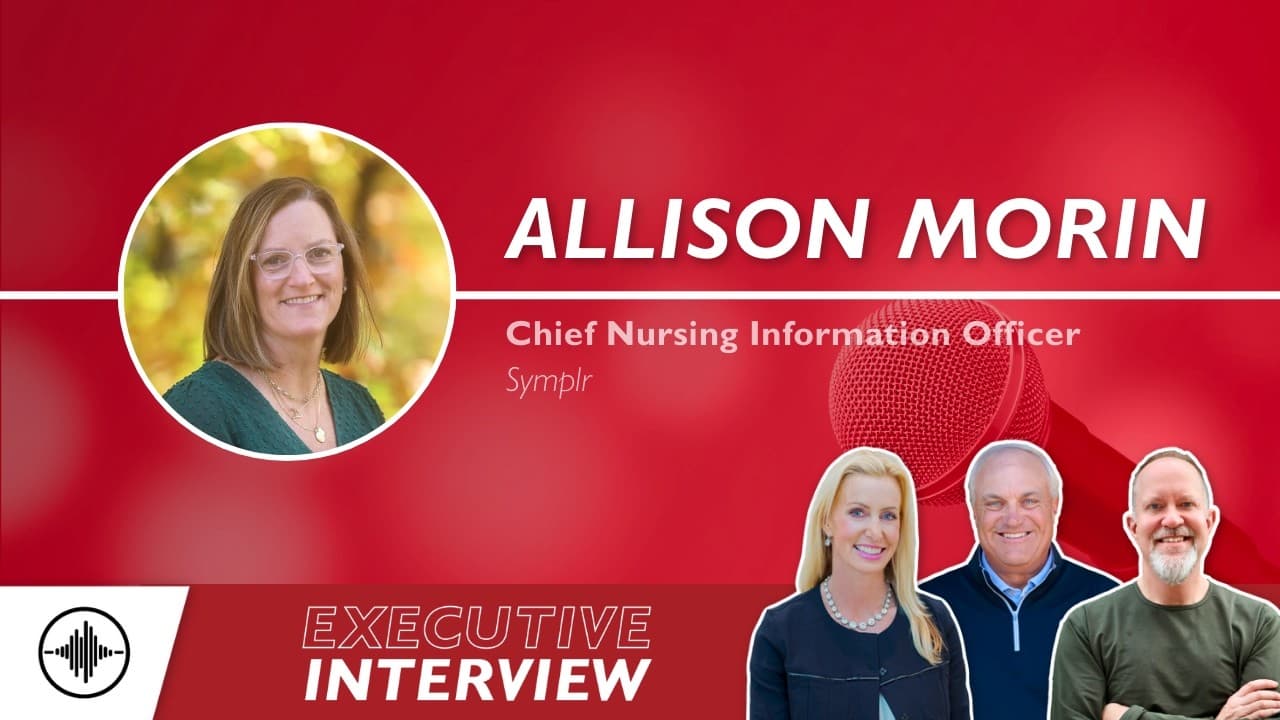
with Allison Morin MSN
February 25, 2026: The nursing crisis is real, and the solutions may be closer than we think. In this executive Interview, Bill Russell sits down with Allison Morin, Chief Nursing Informatics Officer at Symplr, to explore what's burning nurses out and what technology can actually do about it. From staffing automation and ambient listening to AI-powered scheduling, Allison paints a compelling picture of a smarter, more humane future for bedside care. But first, the hard truth: nurses still aren't at the table when technology decisions are made — and that has to change now.
Golf Tournament Registration: https://carahevents.carahsoft.com/Event/Details/686801-ThisWeekHealth
Key Points:
02:10 Do Nurses Have a Seat at the Table?
08:59 The Near-Future Nurse Workflow
12:32 How to Get There: Strategy and Workflow Integration
Donate: Alex’s Lemonade Stand: Foundation for Childhood Cancer
This transcription is provided by artificial intelligence. We believe in technology but understand that even the smartest robots can sometimes get speech recognition wrong.
Executive Interview: Nursing's Biggest Challenges and the Tech Closing the Gap with Allison Morin
[00:00:01] You already know healthcare operations are challenging. Fragmented systems, manual processes, a ton of separate solutions. Simpler brings essential workflow operations together. Supporting the back office functions that make health care go. Nine out of 10 hospitals and 400 plus health plans already use Simpler. Learn more at simpler.com/cio.
[00:00:30] Health, where our mission is to transform health care one connection at a time. This is an executive interview. Quick, powerful conversations with leaders driving change. So, let's get started. All right. Today we have an executive interview and I am glad to be joined by Alli Morren, the CIO with Simpler. And uh Ally, welcome to the >> Thanks, Bill. Thanks for having me.
[00:00:54] >> I'm looking forward to it. We're we're doing a lot more work at the 229 project with CNIO's. We have our first CNIO summit this year. There's going to be a lot of a lot of fun. The world's changing for nurses as we speak. I mean, we talked a little earlier about AI and what's going on there and automation just just straight up automation and and things that are going on. What is top of mind for for nurses right now and and
[00:01:18] and what's going on in their world? Well, we could start at the bedside nurse and we could go all the way up to the chief nurse executive, but really fundamentally they are overwhelmed and burdened with financial pressures and staffing and scheduling. You know, having the right staff at the bedside to take care of patients that's really burning them out. And as you know, we have we're facing a very real nursing shortage and nursing crisis in our
[00:01:43] country. They are dealing with a lot of administrative burden, right? So day-to-day, whether you're talking about how much I have to do in the EMR and whether we're going to implement ambient listening, all the way to I'm a nurse manager and I spend way too many hours of my day trying to figure out how I'm going to fill holes in the next 12 to 24 hours of the staffing schedule. What that means for me as a manager is I
[00:02:05] don't get to be out and be with my people. I don't get to round on my patients. And that really provides a problem for then when you roll it up and you look at patient satisfaction and you look at our outcomes. If I'm not able to make sure that we're practicing at the top of our license as a nurse manager and and pushing that down onto my nurses, then it's really a problem for the chief nurse executive who's then sitting in meetings talking about
[00:02:28] outcomes and patient experience and the turnover rate of the organization. So Ally, please tell me that we've turned the corner, that nurses are at the table as we're talking about these solutions, as we're talking about technology solutions and AI solutions, that they have a seat at the table and they're part of those discussions.
[00:02:47] >> Unfortunately, Bill, not everywhere. There are some organizations that really are are very strong from a health system perspective and they have that you know triad of the CMO or CMIO CNIO CIO together and they're making decisions collectively and collaboratively for the technologies that are being brought into their organization. But the reality is that's the minority of the time.
[00:03:10] oftentimes the the solutions that are being brought in are decided and the nurses find out for the first time when it shows up on their unit or they're being told they need to go to training for it. So, we still have a lot of work to do and some of the work that uh personally I do with the American Organization of Nursing Leaders is really working on transitioning nurse leaders and giving them the confidence to have that seat at the table and have
[00:03:33] them armed to have the discussions about what is the problem this technology is going to solve. And if it doesn't help me keep my staff, make my patients safer or keep my organization strong, I don't want to hear.
[00:03:46] >> Well, I want to talk about a couple of use cases here as we look at this. One is you talked about scheduling. You talked about um the the nurse leader who has to sit there in front of their computer literally in their office in their in front of their computer doing things. Um my personal experience with AI now is if you give it the information it can do permutations th those kind of those kinds of tasks very well. Are we
[00:04:11] starting to see the advent of some of those things turned over to AI to sort of give us at least a first draft that says, "Hey, here's the nursing schedule or those kinds of things." >> 100%. So, we're really excited here at Simpler. We acquired best-in-class Smart Square last year and what we are the most excited about is to your point, it comes with the automation that's helping eliminate those manual tasks of the
[00:04:35] nurse manager. It's also providing enter pride. Tra enterwise >> Not a Star Trek fan obviously.
[00:04:45] >> I know. Right. Right. I know that was hard to get out. But what we're most excited about is it comes with patented open shift as well as a predictive model that allows the nurse manager to not have to do the majority of the work.
[00:04:58] Some cases none of the work when it comes to building that first round of schedules. And it comes just with making some some minor tweaks. So that is all automated and that is where we see the future going for nurse managers and that's just one example. There are many out there where nurse managers are looking forward to how do I reduce that administrative burden on my plate?
[00:05:19] >> I mean is is the answer to the nursing shortage just re taking that that load the load that can be taken off their plate taking it off and that's going to free up I realize it's a crisis. I mean, we're getting to the point where there's just not enough to go around, but how much does that help of just identifi how much time are we talking about that we could potentially take off the the the floor nurse their time and others to
[00:05:44] alleviate some of the stress that's already there? >> I mean, it's a balance, right? So, the clinical care is never going to become automated. You cannot replicate touch and feel of a patient. You cannot replicate any of that. You can reduce some of that documentation burden. There are there were numbers out there and I used to say I didn't go to school to spend 35% of my shift charting. That's real. If we can reduce that, think about
[00:06:08] and it's really not about adding more patients then. Oh, if they've got 35% more time, I can increase the throughput. I can get patients out the door faster. It's not about adding patients. It's about making the time with the patients matter in creating that experience for the patient and giving the nurse the feel that they actually made a difference instead of I'll be right back. I have to go call radiology. I have to go chart this. I
[00:06:31] have to go make sure this is happening. It's about, you know, bringing that time back to to the bedside nurse as well as everybody else who touches that patient. >> I'm curious what the nurses feel is for technology, especially AI. Early on, there was a strike in California >> and they were essentially one of the things they brought up was AI taking over and whatnot. And that was really early on. That was a couple years ago
[00:06:56] actually. What I'm hearing from nurses now is by all means like please I mean that's what I'm hearing. I'm curious what you're hearing. >> 100%. And I think the bedside nurses that workforce optimization component. I think the administrative workflows redefining some things around putting chat bots in and allowing that to be the way that you communicate with the system and not having to click through, you
[00:07:20] know, through a bunch of screens. Serve up information that makes me get in a system and out of a system quickly. I think when you think broadly about an organization, think about claims management, right? Where's where can you get that automation and free up those back office people to be more efficient?
[00:07:36] What about contracts? Organizations have thousands of contracts. I mean, this isn't a nursing thing, but when you think about if we could free up redlinining and make things faster in the contract space, which is what Simpler has a has the ability to do, you could also then free up those people.
[00:07:51] It's all about freeing up that capacity to have a better version of their day, have a better work life balance, have more efficiency in their day instead of logging in and out of so many systems.
[00:08:04] >> We talk a lot about when technology fades. We want the future to be when technology fades to the background >> and they they're just doing their job and they don't even think about the fact that they walk into a room now, they say, "All right, I'd like to I'd like to chart on this patient. you know, here's the blood pressure, here's the respiratory, here's the pulse ox, here's, in fact, some of that stuff's
[00:08:23] just flowing in automatically, the normal things. I'm I'm gonna, you know, document this bed turn and that kind of stuff. Uh, when you think about it, somebody described it to me once. They said, I said, "Well, how how hard is the the charting burden?" And they said, "All right, here's what I'd like you to do. I'd like for you to go through your next week and everyone you talk to in the health system, I want you to document what you talked to them about.
[00:08:49] I I want you to code those in priority, urgency, whatever. I want you to And they just went through this whole thing. And I'm like, and and and they're like, "And by the way, if you don't document all of those, we're not going to pay you like for what you did." I was like >> I'm like, "Okay, point taken. That's yeah, that's a that's a a significant burden. And no nurse or physician went to school and said, "Man, I can't wait
[00:09:13] to get in front of that computer and just start typing. This is gonna be >> You got it. You got it. That is not what any of us said when we got accepted to our academic career. >> So, what what is what does the promise look like? What is, you know, it feels like this this whole train is moving pretty quick. What does it look like for the nurse if things go well in a in a well-run healthcare organization and
[00:09:36] they are not throwing technology at a problem but they are literally solving problems with it in including people have the right adoption approach what does it look like in a year or two for the nurse specifically >> it starts with knowing when she works right so having her autonomy and flexibility to say this these are the shifts I want to work that helps the nurse manager with automation alleviates that whole that whole back and forth of
[00:10:03] the of the life cycle of a nursing schedule. I know what skills I have. I know what kinds of patients I can take care of. So, when I walk in to clock in at 7 o'clock in the morning, which is all smart and automated because it has my phone and it has my badge and I don't have to actually go to a clock and do anything. It just picks it up that I'm there. I walk onto the floor and I am immediately presented with a you know my
[00:10:23] patients that I have been selected to take care of because again the AI and the iterations of the models all say Ally is skilled competent and can work at the top of her license taking care of these five patients on this unit today.
[00:10:37] It's a balanced assignment, right? I'm not going to get all the admissions. I'm not going to get all the discharges. I have a nice balance of it. I have peers that I work with who are similarly competent and skilled to take care of the patients on the floor. And then I walk into a room that is completely smart and it is enabled and I have the ability to your point, ambient listening is everywhere. Good morning, Mrs. Smith.
[00:10:59] My name's Ally. I'm going to be your nurse. It's 7:10 this morning and we're here to give you your medicine. First, we're going to start with this, this, and this. It's, you know, I'm not sure how familiar you are with this medication, but it's this. They have the ability to then that all gets documented, right? Oh, I need a new medication. All of that can be very automated because we already know how many doses we have left of the drug,
[00:11:20] what have you. All of that information from all the bedside physiologic monitors. Oh, maybe I need help. You know, maybe I'm a newer nurse and I need help from a peer. Guess what? We have virtual nursing set up and I have the ability to phone a friend and I can say, "Hey, Betty, you've been a nurse for a lot longer than me. I have a question about how I take care of Mrs. Smith. Can we do this together?" and then I have a
[00:11:41] peer that can help support me in my professional growth and and I've got, you know, a a partner in crime to help me with Betty Smith. I think it is all of that. And I think it takes away all the hands-on keyboards. It takes the law. I mean, we all had smart badges, right? You probably at your organization tapped in and tapped out of the EMR how many times a day? All of that goes away.
[00:12:03] That's a burden. That's an administrative task. Typing in my password's an administrative task. How do we take that time of our systems? I mean, I'm a I'm a generation where I started charting on paper. I was a paper nurse, right? And I had my flowheet and I was out the door at 7:30, right? I transitioned to the EMR and we had one laptop on our floor when we went to the EMR and I was the only person on the
[00:12:29] floor who took the chart with them because I was like, I'm gonna get this done. I still want to leave at 7:30. So, I charted in my rooms, right? It's that whole how do I do the work and reduce the burden through all the tech and leverage the technology we have. There's so much exciting technology in front of us. But just because you can doesn't mean you should. You have to really make sure it's part of your whole portfolio
[00:12:53] of solutions that support the clinician. So, someone who's listening to this who hears that future and says, "We have a couple of those things, but man, that whole picture sounds really appealing to me as a as a a CIO or or nurse practitioner or even a CMIO or others, they go, man, that sounds like a really good future. What do the steps look like to get from here to there?"
[00:13:16] >> Well, I think if you're a CIO, hopefully you're part of that vision and you're part of the decision-making and you're sitting at the table and you're part of the AI governance structure. If we're talking about AI solutions and you're participating in that organizational strategy, if you're not, you should be and you should bring your friends along with you because we need more nurses at the tables making those decisions. I
[00:13:37] think you have to look across your entire organization and you need to look at all of the users, all of the clinicians and think about how do we connect these workflows? How do we connect these solutions? Because everybody having hundreds of solutions in your organization is hundreds of loginins. It's hundreds of of vendor partnerships. That's too many. We need to really get to the point where you have strategic partners that you can
[00:14:02] work with who can bring you the best of the solutions, right? So you don't need to look at all the people who have all the technologies. Um I think it's really about making sure that you have a vision and you have a pulse on the clinicians and the people who put hands on patients. There needs to be rounding.
[00:14:19] There needs to be a voice. There needs to be a place where they can be heard so that as you're making selections of the technology to get to that vision, you're you're you have a seat and theirs is the voice you're speaking with.
[00:14:33] >> I'm cheering for that future. I think a lot of people are cheering for that future. So hopefully have some good conversations coming up at some of the conferences and uh we we can help to move that forward. Thank you. Thank you for your time today.
[00:14:45] >> Thanks, Bill. Thanks for joining us for this executive interview with me, Bill Russell. Every healthcare leader needs a community they can lean on and learn from. Subscribe at team. Together, we're transforming healthcare. Thanks for listening. That's all for now.
Keep exploring
Executive Interview · Oct 28
Executive Interview · 19 min listen
Executive Interview · 26 min listen
Executive Interview · 17 min listen
Executive Interview · 26 min listen