
 Apple Podcasts

Flourish · ~54 min listen
with Kristen Schmidt
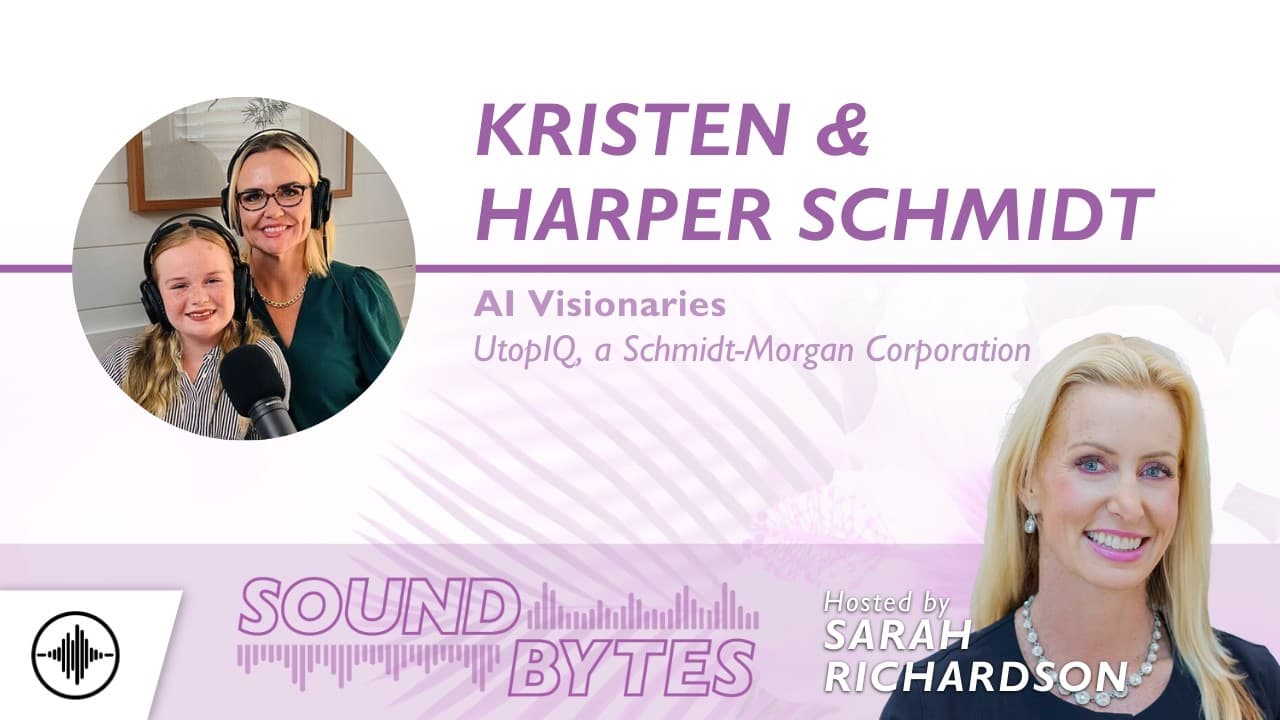
April 24, 2026: In this conversation, healthcare tech entrepreneur Kristen Schmidt and her 11-year-old daughter Harper explore what it means to prepare the next generation for a world shaped by AI. Harper's definition of AI — insightful beyond her years — anchors a candid discussion about the growing gap between AI's rapid advancement and youth readiness. For healthcare IT leaders, the episode raises an urgent question: are we building the right foundation for the leaders who will inherit these systems?
Keep up to date on the latest in health IT:
https://thisweekhealth.com/news/
Key Points:
01:07 Teaching AI At School
03:39 Raising Female AI Leaders
12:20 Harper On Hollow AI
17:36 Wrap Up And Call To Action
Donate: Alex’s Lemonade Stand: Foundation for Childhood Cancer
This transcription is provided by artificial intelligence. We believe in technology but understand that even the smartest robots can sometimes get speech recognition wrong.
Flourish Rerelease: Raising the Next Generation of AI Leaders with Kristen and Harper Schmidt
[00:00:06] Hey, it's Sarah Richardson. Before we jump in, a quick note. This episode originally aired on Flourish, a show I hosted focused on leadership and culture in healthcare IT. Flourish has officially joined the 229 Project Podcast, and over the next few weeks, I'm bringing some of my favorite conversations with me. If you're new to my work, I'm so glad you're here. And if you followed me from Flourish, welcome home. The conversation you're about to
[00:00:27] hear is one I believe is worth your time. Let's get into it. Welcome to Flourish Sound Bites, where today we're diving into AI from a deeply personal and powerful perspective. What it means to teach our daughters about AI while building it ourselves, and we are joined by Kristen and Harper Schmidt. Ladies, welcome to the show. Thank you, Sarah.
[00:00:50] It's wonderful to be here. I'm really excited to have Harper with me, too. Yes. I'm excited, too, because you are the first mother-daughter team, and Harper, you'll be the youngest guest ever on Flourish. So, thank you for joining us. This is going to be amazing.
[00:01:02] But, let's jump in and really talk about the mother-daughter lens when it comes to artificial intelligence. Kristen, you recently taught a class on AI in Harper's school. What inspired you to do Yeah, so Sarah, this was done nearly entirely on a whim one Friday afternoon.
[00:01:18] I had heard that Harper's school was grappling with the best way to introduce a more structured and focused conversation around AI. So, I reached out and offered my time one afternoon. I felt as if I benefited more from the time together with the children because it really, Sarah, reaffirmed my intuition that the youth are being somewhat overlooked here with this AI movement that's happening. Certainly not
[00:01:43] in an intentional manner, but because of the speed here of developing AI and the race to competitively position the US here as a global leader within AI, we've not paused long enough to think about future generations that will be impacted. And so the dialoguing and survey responses were really So I really feel like it was a divine intervention to me saying, "Kristen, this is your
[00:02:08] calling. This is your purpose. Now go do this. Go be the voices for for children and for youth with the AI movement." And you've had some great results from the students and the teachers. What were some of the things that they said that may have surprised you and may not have surprised you?
[00:02:23] Yeah, so there were some really interesting responses, Sarah. I went back through them this morning. The notable themes that emerged from the questionnaires that we distributed were really twofold. One, there was concern about how AI would infringe upon their constitutional rights. So think about that answer, Sarah, coming from an 11-year-old, a 12-year-old. That's pretty profound. The second theme was
[00:02:49] just a general feeling of uncertainty with AI. What am I supposed to know about AI? How am I supposed to use AI? So those really were the top themes that we pulled out of the surveys and those responses definitely kind of fueled this call to action here where we're using our AI startup as a platform to create this AI youth coalition that's live right now and we're going to be lobbying
[00:03:14] and really raising awareness about this high-risk gap. When you think about constituent, everybody thinks about adults and stakeholders within those age brackets, but nobody's stopping to think about youth and the decisions and the regulations that we're putting into place today is going to have a huge impact on our children and their children's generation.
[00:03:36] It absolutely will and I'm glad you're taking it head-on. And I'm curious also, how was the experience of teaching Harper's classmates, spending more time in this space? How has it changed the way that you two approach conversations about artificial intelligence? Cuz Harper, you are a mature, precocious, very forward-thinking young woman, and it's been really impressive just to even see your involvement in some of these aspects.
[00:03:59] But, what should our audience know about the conversations you two are having? Yeah, so her school is definitely aware of the facts that I am dabbling in an AI startup, and I think that certainly sparked a greater interest, and I'm starting to get asked more about AI and tips and tricks for going back to school and just having those conversations with classmates and their family. But, what I can tell you about the way that this
[00:04:22] experience has changed my perspective, Sarah, on this is Harper concluded her spring semester on a somewhat triumphant note. So, she's been able to advance to the level where this next school year she's going to pick her passion area of focus, in which the following year she's going to start to enroll in college credit through an affiliation with Oxford. So, this was really, really
[00:04:46] exciting, but at the same time provided a somewhat sobering reality check for for Mama Bear over here in the sense that I have not thought that I was running out of time to prepare her for and equip her with the right knowledge to promote the right usage of AI in her studies and as as she she embarked on her collegiate career. I just felt like I had more time. So, entering this new
[00:05:12] school term in the fall, what my husband and I are going to be doing is being more disciplined and consistent with the AI learning and the teaching to make sure that we're providing the right oversight now, Sarah, and monitoring her progress and the use of AI. And so, as she starts to demonstrate that she's mastered the basic understanding of AI, we'll begin to kind of build upon that, but we have to be able to see that she's
[00:05:38] grasping and understanding the content. So, when it comes to querying any kind of open AI platform, I want to understand and see her become more intentional and advanced in the way that she's prompting the software. So, just taking it phase by phase, but all to come back to we thought that we had more time. Holy crap, this is not a very long way to try to get her ready to tackle
[00:06:05] some of the freshman courses, but at the end of all of this, Sarah, I want to prepare Harvard to be part of this generation of female AI leaders who will reshape how we develop, deploy, and govern artificial intelligence systems in the industry that she ends up choosing. So, that's kind of been a culmination of what the teaching and the interaction with her classmates has
[00:06:30] produced. It is so impressive because we know through research and other aspects of really cybersecurity leadership that women, especially, have a different lens that they look to when it comes to educating their families, protecting their families, etc. And so, there's a little bit of a difference in how women are approaching this space. Love that you're leaning into it because I'm curious also from your perspective is
[00:06:53] how do you female or mom-led AI initiatives, what do they bring to the table that might be missed? And also, what is the risk if we don't face those types of perspectives head-on?
[00:07:06] I love this question, Sarah, so much for a multitude of reasons. Women are instinctually wired to ask who will this hurt? Who will this impact versus what can we achieve out of this? What is the end result? What is the outcome? So, I hypothesize that AI initiatives, Sarah, led by women and mothers will likely prioritize safety and risk management more heavily than those led by men. The
[00:07:32] current AI landscape is characterized by intense competition and rapid development. And rightfully so, there are extraordinary stakes here on a global level, but with this G4 there's been less emphasis on safety and collaboration. And I just suspected this pattern reflects the broader gender differences in how leaders approach
[00:07:56] strategy and execution in the AI field. Both are needed, but we can't be too top-heavy with one or the other because then we start to become unbalanced and then that's where we're going to have real risks.
[00:08:11] Couldn't agree with you more. And I'm also wondering as parents think about AI education for their children, is it different for young girls and young boys? Or what are some of the most important areas we should really be focusing on in terms of their awareness and education of AI?
[00:08:30] Yeah, that's a great question, Sarah. For Harper, I'm just going to use her as the example here. There are three areas that my husband and I have agreed that are really worthy of our focus time with her around AI to help her really understand the fundamental purpose of AI and how we can be good stewards of AI.
[00:08:50] And those three areas are modeling collaborative AI usage rather than And Harper and I were discussing this this morning, rather than like stockpiling and hoarding the AI capabilities, let's share to promote the fabric of society to help really expand our capabilities and achieve bigger and better outcomes.
[00:09:12] That's the first focus area. The second area is we want to prioritize AI literacy over AI dependency. And we've had so many conversations about this, and AI dependency, Sarah, is quite frightening, and it's a very real risk to youth and adults. So, what we're wanting to do really teach her to think independently and use AI to complement or strengthen the work that she's doing.
[00:09:39] So, that's the second focus area. And then the third is we want to focus AI on solving real human problems and not just technical challenges. The industry releases and podcasts and interviews that I'm seeing that are making some pretty notable headlines are 80% around solving technical challenges and not real human problems. So, I'm excited for
[00:10:04] Harper to share with you in a minute one of the things she's been using AI for to advance her and to give her a leg up for the fall term. What's so fascinating about what you just shared is about how it is used as a tool and also helping with even human challenges because you're still going to have to write a paper. You're still going to have to probably create your table of contents and your bibliography.
[00:10:27] And that dependency that people rely on now, think about how many phone numbers Kristen you and I knew growing up and how many phone numbers we actually know now because everything is speed dial or voice command that is. And it's kind of disturbing over the fact that I've absolutely no idea where some of the things that I used to be really good at, which was the memorization of numbers and patterns, don't do as much anymore
[00:10:51] because we've gotten dependent and very comfortable with the technology. So, the last question for you Kristen is what is something you wish you had known about technology when you were Harper's age?
[00:11:03] So, I thought about this question quite a bit Sarah. I grew up in a very conservative household, daughter of a preacher, and technology had a very negative connotation. I feel as if this negativity this negativity Sarah was largely due to just lack of education and lack of information that was available to my parents. Technology was largely viewed back when I was Harper's age as really solely entertainment
[00:11:29] versus as a tool that could unlock innovation. And so, I really wish that I would have had an opportunity to embrace a higher education in technology, but we take that learning certainly and and we've applied that forward here. We found an exceptional leadership entrepreneurial academy that is local to my hometown that embraces innovation and technology and really preparing our
[00:11:53] children with real-world skills and knowledge that they're going to need to be good citizens and productive successful adults. So, that's something that had I had an opportunity to change at her age, it would have been earlier exposure to technology. So, I'm a little envious at what Harper is getting exposed to right now as a podcast participant at 11 years old. Like, that's really unreal and I'm just really
[00:12:17] excited that our youth have these Well, I'm excited too cuz Harper, you're up next. So, let's be honest. I mean, you've got a mom who's built this incredible AI company specific to protecting others. And you have all this exposure in your own, you know, home and school, but then you're also a little bit of an entrepreneur on the side.
[00:12:36] Might I say I have something I want to ask you about. You already have your own candle company and you're 11. Um and by the way, her candles are awesome. I've already bought a whole bunch of them and give them out as gifts. So, I love how you literally are locally sourcing so many elements of your life. But, let's jump into the AI questions for you, Harper. What do you believe AI is in your own words?
[00:12:58] Holo, the absence of life, but it is also an idea maker and it doesn't know how to tell the difference between bad ideas and good ideas. And that's why I use the phrase When you consider what would be a good idea or a bad idea, how do you differentiate and when you see something come up in AI?
[00:13:19] Something that can help our community, something that can help our entire state possibly, our entire country. That's what I think. It goes back to using it for the good of humans, which I love.
[00:13:31] Harper, if you could create an AI tool to do anything, what would you want it to do? It would help scientists create biotechnology plans specializing in And not just conservation plans, it make a plan on how to do it most efficiently. And that's what the tool would be. In fact, I've actually been working on some biotechnology papers. I
[00:13:57] created a paper that people can learn about how biotechnology can help save red wolves and actually bring back albino gorillas. And I just use AI. And I use ChatGPT cuz that's the easiest thing I can find. And I can use it to I can feed my ideas into ChatGPT and then I can just ask it to create entire biotechnology paper for me. And then I
[00:14:25] only have to do it once. And then the next time I just have to change the details and just say create a biotech paper for me and then it just does the exact same thing, just different So you have the template that you've wanted and you just start plugging in different types of animals or different opportunities when you think about how to almost reverse engineer some of the perspectives that you're experiencing or learning in school.
[00:14:47] Yes. Good. I love that. How do you want to use AI in your job or in your future? the job you're going to have is not the job that even exists today.
[00:15:00] And you're setting the pace for a lot of others who are who are you thinking about the usage of AI. What kind of job would you want to have and use AI to help you be that much more successful?
[00:15:12] Biotechnology. I just love it. It's like the idea of recreating an animal using technology makes me just blown away cuz I think it's so interesting. And I think it'll be involved with my job and not just that.
[00:15:27] I think it'll also be involved with um my journey through college and helping me be more efficient on how I get my studying done. And it'll help me especially since I'm would like to major in biotechnology.
[00:15:45] I feel like you're going to be running like Jurassic World at some point with all kinds of new creatures. I'm going to ask you a question that we have not talked about simply because I believe you can handle this one. And for whatever reason an animal may have gone extinct.
[00:16:01] What is our responsibility if we decide to bring something back? Is it a good idea if we can bring back a T-Rex, should we?
[00:16:10] Um I do not believe we should because I see it as this way. Nature can keep itself in check. And so basically animals that have gone extinct through I think that they have gone extinct for a reason, perhaps to make room for us humans. And I think that animals have gone extinct because of humans should be brought back because without those
[00:16:37] animals it could possibly lead to detrimental things happening to our ecosystem that are very important like um the red wolf going extinct. Uh a very mature answer and thank you because if we cause them to go away, what do we have to un-cause for them to be able to thrive? And I can see with the center of like the Dian Fossey and the Jane Goodall conversations, which I'm sure you already researched those amazing
[00:17:02] women. And Jane Goodall's still with us. Things that she thinks about in terms of longevity of a species and things that we can learn from them. Thank you for your perspective. And my goodness, I cannot wait to see what the next few years from you hold. I know you'll be a repeat guest because there's a future of voices like Harper's that you're like, "Wow, I feel really good about the future when I get to speak with someone
[00:17:26] like you." Harper, thank you. And Kristen, no surprise because we're friends and I know how you parent and I'm like, "Dang, if I could have had a Harper, I might actually Thank you for the opportunity, Sarah. I would say that this podcast opportunity in collaboration with Harper has helped spark even more dialogue in between the two of us as we've really thought through the questions and really wanted to make sure that we were speaking from
[00:17:49] the heart. But I think the more we can encourage open communications and conversations locally within your schools, within your community, within your families, the more you talk about it, the more you'll understand it. So, I would just encourage that as a learning and something that's obviously been beneficial and of value to us as we've prepared for this conversation with you today, Sarah.
[00:18:12] Oh, absolutely. And Harper, you nailed it. Like you just get it. You're sitting here you're like, "Oh, I have an answer for that." I almost want to make up new questions to ask you so the curiosity of of what you may say, but again, thank you for your preparedness, for your advocacy, for all the things you're doing to represent you and Kristen giving her a platform to be able to do that responsibly and safely. And this
[00:18:31] episode reminds us that AI education isn't just technical, it's generational. please share this episode with a fellow parent or educator and tell us how are you talking about AI with the next generation. Again, Kristen and Harper, thank you so much. Can't wait to see you both soon. And those of you listening, that's all for That's Floor Soundbites. Find your community at
[00:18:57] Every healthcare leader needs a community to learn from and lean on. Share the wisdom. That's all for now.
Keep exploring
Flourish · ~54 min listen
Flourish · ~21 min listen

Flourish · ~54 min listen
Flourish · ~28 min listen