

 Apple Podcasts
Solution Showcase · ~18 min listen
22:11
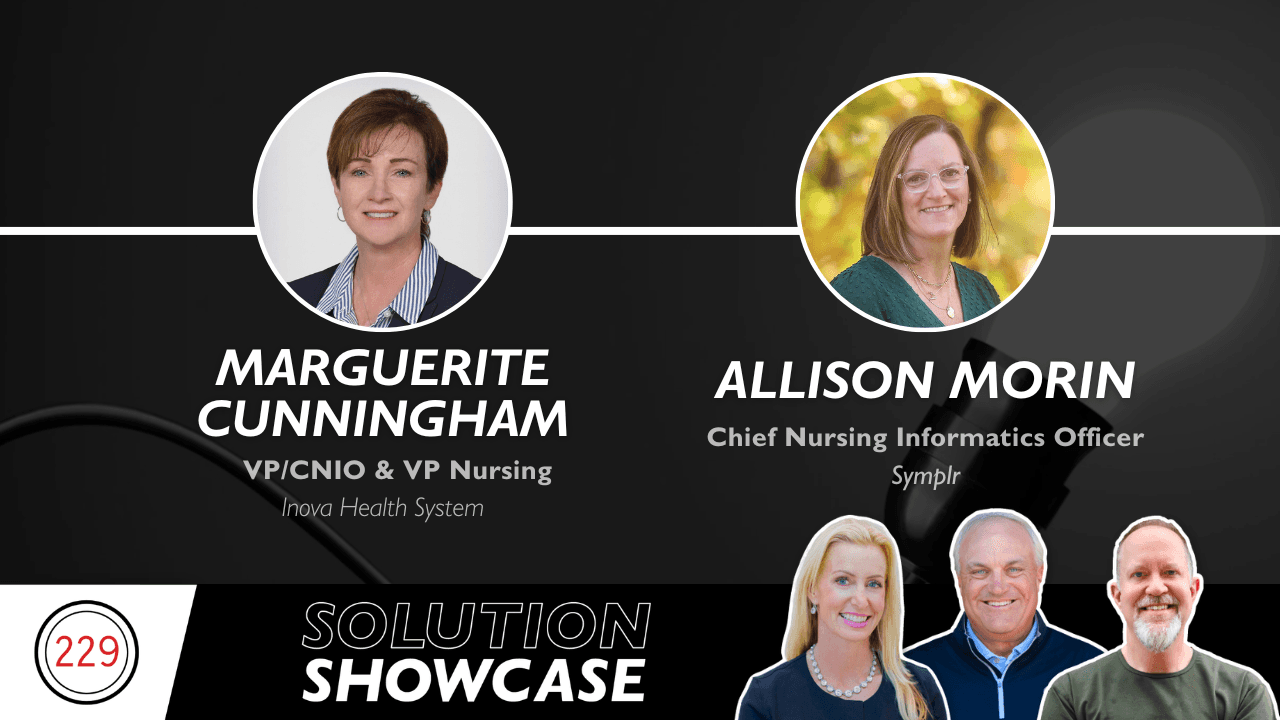
with Allison Morin MSN and Marguerite Cunningham
August 12, 2026: Marguerite Cunningham, VP/CNIO & VP Nursing at Inova Health, and Allison Morin, Chief Nursing Informatics Officer at Symplr, join Sarah Richardson to unpack how workforce management stopped being a scheduling problem and became an executive one. Maggie shares how Inova's Smart Square rollout, born out of pandemic urgency, forced the system to build real governance around staffing instead of just automating a spreadsheet. Allison brings the national view: predictive accuracy up to 97.5 percent, contingency spend cut nearly in half, and a shift from descriptive to prescriptive workforce management.
Key Points:
01:22 Roles and Why It Matters
06:06 Governance Before Tech
13:08 Results and Future AI Staffing
19:42 Advice and Closing Thoughts
Donate: Alex’s Lemonade Stand: Foundation for Childhood Cancer
This transcription is provided by artificial intelligence. We believe in technology but understand that even the smartest robots can sometimes get speech recognition wrong.
Turning Staffing Into an Advantage | Solution Showcase with Allison Morin and Marguerite Cunningham
[00:00:00] Speaker: You already know healthcare operations are challenging. Fragmented systems, manual processes, a ton of separate solutions, Simpler brings essential workflow operations together, supporting the back office functions that make healthcare go. 9 out of 10 hospitals and 400 plus health plans are to use Simpler. Learn more at simpler.com slash CIO.
[00:00:28] Sarah: I'm Sarah Richardson, a principal here at This Week Health, where our mission is healthcare transformation powered by community. Welcome to this solution showcase, highlighting tools that empower healthcare teams. Let's explore what's possible. Welcome to the 229 podcast. I am Sarah Richardson and so excited to be able to be joined by Maggie Cunningham from
[00:00:47] Speaker: Enova Health, as well as Ali Morin from Simpler to talk about technology as a catalyst for workforce transformation. Ladies, welcome to the show. Thank you, Sarah. Yes, and this is going to be such an interesting conversation because healthcare workforce challenges are not about staffing issues per se. They are operational clinical and technology priorities,
[00:01:11] Speaker: and today we are exploring how Enova Health and Simpler have brought practitioner leadership and technology partnership together to rethink workforce operations. So Maggie and Ali, to ground our audience, could each of you briefly introduce your role and share what makes workforce transformation especially important from your perspective.
[00:01:33] Speaker: Thank you, Sarah. So my role as CNO is to ensure really that the tools, technologies, the innovations that we ask our team members to adopt fit seamlessly into their workflows. Healthcare is changing and we need to change with it. So technology development and AI enablement are accelerating at really rapid paces right now and our organizations who don't change are going
[00:01:58] Speaker: to struggle. We need to transform our workforce and care models to meet healthcare's changing needs. One large area of focus is our nursing staffing and care model. By partnering with our technology vendors and creating new workflows supported by technology, we have an opportunity to change our care model, focus not on ratios but on the work that we do to ensure excellence in care.
[00:02:20] Speaker: Maggie, I'm Ali Moore and I have the privilege of serving as the Chief Nursing Informatics Officer here at Simpler. And the best part of my job is I get to work with customers like Maggie and Enova where I get to hear how the cutting edge models of care and changes in care delivery are impacting nursing the nursing workforce and then take that back to our teams
[00:02:43] Speaker: and see how can our solutions meet them or beat them to where they're trying to get to from an operational perspective. So I really get to sit in between the practice of nursing as a pediatric critical care nurse. That was one of the favorite things I love to do but now my favorite thing is to deliver technology that helps them have a better experience at the bedside. Fantastic. Thank you both. So let's begin with the challenge that prompted the work. Maggie,
[00:03:07] Speaker: for you, how did workforce expectations and the operational realities associated with that change for Enova after COVID? And what made it clear that the different approach was needed? So Enova was in the process of adopting Smart Square right around the time that COVID hit. And so the pandemic associated staffing challenges accelerated our development.
[00:03:31] Speaker: We stood up our central staffing office to help identify needs and reassign nurses and other clinical and non-clinical support team members across the system to where they were needed most. This was the beginning of our clinical staffing journey. We immediately appreciated that we can not only track and reassign staff across the system from a central location, but we were also able
[00:03:55] Speaker: to store information on our team members in Smart Square, including the units and locations for which they were qualified and trained to work. So it was a real game changer for us. And Ali, across the industry, what patterns are you seeing that have elevated workforce technology from a scheduling tool to more of a strategic CXO priority?
[00:04:16] Speaker: Great question, because we do have purview across the whole country and health care systems big and small. So what we've seen the biggest shift is that workforce management has really moved from an operational function to a strategic priority for the organization. After COVID, health care systems and leaders really realized that staffing volatility impacts much more than just
[00:04:39] Speaker: the staff on the floor. It's the clinical outcomes of the patients. It's the employee engagement and retention capacity management. If you don't have enough staff and your capacity is going up, you got to fill the need. And how are you going to get there? Access to care. If you don't have enough people in the building to take care of those patients, they're going to go somewhere else where you may lose patients to other organizations. And then just overall organizational
[00:05:01] Speaker: performance, regulatory bodies come in and can sense and feel that kind of stuff. So at the same time that those workforce expectations have changed from the clinician perspective as well, clinicians want more flexibility. They want transparency and they want to have fairness in when and how they get scheduled to come to work every day. So those executives have realized that this is more than just a schedule. It's more than a spreadsheet. It's more than a share point.
[00:05:25] Speaker: It's more than a group me. It's more than a Facebook group. They need that visibility into the future demand, the staff that can fill the demand, and then that incentive utilization so that they can see when do I really need to be able to flex and spend some money to get people to work the shift so that I'm not in the crunch time at the end of the scheduling process, scrambling to hire travelers
[00:05:46] Speaker: or bring in per diems to fill a shift. And then that staffing risk so that they can make decisions ahead of time, like I said, so it's not a crisis at the last minute. That's why workforce is becoming an executive conversation, including not just nursing, but HR, IT, finance, really not just the staffing offices. That's what we see. Yeah, well, we've each experienced that technology
[00:06:10] Speaker: can accelerate transformation, but it doesn't create alignment on its own. So Maggie, before technology could deliver its full value, what foundation did Enova need to build across governance, executive alignment, even the cross functional collaboration and process standardization? We put the car before the horse when we did our implementation. So we had to roll it back in a
[00:06:34] Speaker: little bit as a result of the pandemic and the urgency for standing up Smord Square. However, with the guidance and partnership of our Smord Square team, we were able to identify the value and have a solid governing structure. We identified our appropriate oversight committees, including our core team to set the strategy and work collaboratively with our vendor to ensure
[00:06:56] Speaker: we keep our system up to date and take advantage of everything that the system has to offer. In addition, we run monthly optimization councils to ensure the proper communication of system changes. We also address any challenges or questions our elevated users have bring to the committee. And from a leadership level, we meet with Smord Square on a monthly basis.
[00:07:18] Speaker: This meeting includes our CNE, myself, and the Smord Square leadership team, where we discussed strategy and changes in health care and how our partnership helps to support our team members and the hard and hardwire processes. We have developed key learnings from our discussions and we share those out with the five hospital CNOs across our system and push those down
[00:07:41] Speaker: then at the system level. And this is for both of you. What did the effective partner, practitioner, technology relationship look like during that work and how did candid collaboration help you navigate change and continue optimizing it together? Our Smord Square install was a true partnership between Smard Square and ANOVA IT clinical and clinical team members. We really
[00:08:04] Speaker: wanted to make sure that we had the nurse at the bedside, her voice in the discussion. It was important for us to understand our pre-thapping workflows and ensure that we meet frequently to avoid gaps and ensure that we remain aligned throughout our install process. Those meetings continue today with IT, Smard Square, our elevated users, and even the team members from our resource
[00:08:29] Speaker: management center. Yeah, and from our side, I think, honestly, the most successful partnerships start long before technology goes live, right? The value of that partnership was developed through getting through the fundamentals, creating managed governance structures that Maggie was talking about, the operational consistency and getting alignment across the leadership at ANOVA and across other customers as well. I mean, it's simpler we bring that perspective and lessons
[00:08:54] Speaker: learned from our other customer base, but the transfer, the transformative results really happen when the customers like ANOVA and leaders like Maggie actively partner with us to help define what's the problem they're trying to solve and what's the future state they're trying to get to. That's one of the reasons why we're honestly consistently recognized as best in class. Thanks to our customers who tell us that we're the best in the business, but that feedback doesn't just
[00:09:18] Speaker: reflect the technology, but the strength of our partnership and our commitment to helping organizations get those outcomes. It's, you know, technology's never where you start. Like, let's just go put technology in. It's really about that foundation. Once you have the foundation in place, you turn to how the technology can support that strategy. And so Maggie, what led ANOVA to smart square? How does it support centralized
[00:09:41] Speaker: staff being the enterprise visibility and also your shift from ratio based staffing towards workload based and the equitable nurse assignments that go with that. Prior to arriving at ANOVA, our chief nurse executive had worked at a rapidly growing health system in New Jersey. And in order to assure that their staffing was well managed and equitable
[00:10:04] Speaker: across the system, she evaluated vendors eventually landing on smart square. Their predictive model, the load balancer, and the ability to offer high premium shifts set them apart from other staffing systems you had to rebute. No, we don't currently use the premium shifts, but we know that they're there if we need them,
[00:10:23] Speaker: and we'll rely on them when the time comes. The big job is to be able to see across the system from a central location. Smart Square isn't easy to access reports and analytics, and we are currently reviewing the opportunity to do a deep dive on our instant on a work time, as we're currently reviewing the opportunity to do a deep dive on instant on a work time, as we've recently noticed it trending in the wrong direction.
[00:10:48] Speaker: But at the end of the day, it was the relationship and partnership that she experienced with the smart square team that really sealed the deal on our commitment to work with them. Their commitment to excellence and customer service sets them apart from the competition. And so building on Maggie's experience alley, which smart square capabilities make
[00:11:09] Speaker: that model possible, and how to predictive insights, integrations, and incentive visibility help leaders make better staffing decisions. Yeah, Maggie, Maggie really spoke to a lot of the benefits of the smart square platform, and it is that enterprise visibility across the whole system. So creating a central staffing office to have visibility across everything,
[00:11:29] Speaker: the predictive insights where you we have the ability to predict within one person, one staff member 120 days out up to 96% of the time accurate, which gives the tremendous opportunity to proactively manage the staff, instead of reacting to it. So that predictive forecasting helps them anticipate the workforce needs long before they occur. I mean, 120 days,
[00:11:53] Speaker: right now we'd be planning, you know, for the fall and Thanksgiving potentially based on how far out so being able to have that visibility ahead of time. And that proactive planning ultimately saves you time and money. So if you see it in advance and you can predict it in advance, you can get staff to pick up shifts with our open shift and incentive model, which gets that
[00:12:14] Speaker: happening earlier in the lifecycle of a schedule. And then what you get is at the tail end, you're really just filling those call ins. And so you're saving money because you're not incentivizing at the end, you're incentivizing early, but at a lower rate. And then those integrations as well. So leaders are have a whole connected workforce. So, you know, Maggie talked a little bit about how they're going from ratio based in there, you know, looking at a whole, a whole platform of how can
[00:12:39] Speaker: we use the other technologies in place. And we are in equal part of that technology, because you know, the acuity of the patients, the staff who are in the hospital, and the visibility of who do I need who do I have available to take and put where is really what differentiates smart square in the market. And ultimately, the value in is how the work changes decisions and the experience is
[00:13:00] Speaker: not just in implementing a platform. Maggie, what changes have you seen in staffing visibility, the decision making, the operational consistency, or even the clinical experience as this strategy has matured. The ability to sell schedule was introduced in our to our team members several years ago. It not only relieves the burden off of the scheduling coordinators, the RN leaders,
[00:13:24] Speaker: and the leadership, whoever really does the schedule, but it's also a huge satisfy for the team members in that they can schedule around their personal life. Many do this right from the smart square app on their phone. Reduction in travelers, better system visibility to identify and and cancel
[00:13:47] Speaker: over time, and enabling clear decision making through system configuration, all our benefits of what we're seeing with by using the smart square tool for our staffing. Our administrative directors are the last line in the chain in terms of when at the end of the day, when the stacking is done before a shift, they take a look at it can make additional tweaks if they need to.
[00:14:10] Speaker: But they see the availability of resources across the system, where we place flow pool nurses, and ensuring that that placement is really the appropriate for their level of care and their skill set. Again, Ali, without identifying individual organizations, what broader customer outcomes or quantitative examples help illustrate what is possible when the operating model and technology
[00:14:32] Speaker: come together. So we had an organization that was able to consolidate three staffing centers into one to a full centralized staffing office, which gave them that enterprise transparency. And during the pandemic, within 10 months, they reduced contingency spent from 23 to 17%, which is not insignificant. And I think maybe more importantly, they achieved a 93% nursing
[00:14:55] Speaker: fill rate. So that flex pool expansion from 26 FTEs to 90, because they had the visibility of where am I going to need to put people? And then I mentioned the 96% accuracy within one person, 120 days out, they actually got 97 and a half percent accuracy with our model. So that was pandemic driven, but that was really, you know, a really great outcome for them to experience
[00:15:18] Speaker: during such a terrible time for health care. And then we had another organization that had $31 million in saving of labor expenses in nine years. So 10 million overall for one year, which is crazy. So they reduced the RN average hourly incentive by 50%. Again, because you can incentivize early in
[00:15:39] Speaker: the process. And you have, I just, I'm like a broken record, the visibility of the enterprise visibility in the system, ability to see who are the resources I have, what are their skills, and how can I, you know, position them to take care of the right patients to let them work at the top of their license, but also fill the needs of the organization so that we're not overspending on
[00:15:59] Speaker: on agency. From our retention, recruitment, even a loyalty perspective of the staffing, what a huge win. And then obviously the patient experiencing that added joy to the things that don't need to be in the way of providing great care, because workforce needs are going to continue to evolve. So I want to take a peek ahead, Mrs. for both of you, as workload intensity and the
[00:16:21] Speaker: workforce expectations continue to change, where do you see the greatest opportunity for smarter staffing models, whether that's the AI enabled decision support and the continued partner innovation. I'm really excited about these opportunities. I love thinking outside the box and being on that leading edge. Our organization is currently working with our enterprise workforce
[00:16:41] Speaker: management system, extracting information and integrating it with our EMR to allow us the ability to have an informed patient assignment that will allow us to match the staffing skill sets to the clinical assignments. So these assignments will take advantage of the patient workload intensity score, and will allow us the seamless assignment from smart square to the right patients and the
[00:17:06] Speaker: right caregiver forgoing the more common team member to patient ratio. AI also has a place in this new care model and may provide new efficiencies in staffing by supporting the appropriate assignment a flow pool, travelers and other OT or staff members to the most appropriate clinical care area,
[00:17:27] Speaker: matching their skill sets and the workload intensity is needed. And I really think that that automation and AI are taking, you know, taking us into this next frontier from descriptive workforce management to prescriptive workforce management. So that's how we think about it. The leaders today, we can tell them what's happening and what's likely to happen. The future is helping
[00:17:47] Speaker: leaders understand what action to take, right? So that AI and automation is constantly scanning and making recommendations and serving them up to the leaders to act on that decision support just has such potential, in my opinion, to really help organizations balance the workloads and the workforce preferences and skills like Maggie was saying, with patient needs, just that whole overarching
[00:18:11] Speaker: picture of, you know, care delivery around the patient with the right people in place. And it's not replacing the leadership judgment, there is always going to be a human in the loop as they say, it's really just augmenting it with better recommendations. And you know, think about the ability to open up a schedule and apply your cyclic patterns at the beginning of the six-week
[00:18:31] Speaker: schedule. And you really don't have to touch it, right? Like, how great would that be to be able to have automation deliver that and allow a nurse manager to review, make the appropriate tweaks she needs to or he needs to, but then really just being hands off because the tool, you know, the algorithms are all aligned and delivering what's expected from the nurse manager or the
[00:18:56] Speaker: nurse leader. So that's what we're really excited about is decreasing that administrative burden and giving those leaders time back to elevate their staff and visit with patients and develop themselves. Right. I'm so glad you touched on the part about serves up the recommendation and keeping the human in the loop because you're right, you remove that administrative burden. But then I have never
[00:19:17] Speaker: met a pool of professionals that have a better use of intuition than nurses. And you give them plenty of space to be able to say, and this still needs to be true as well. And so being able to incorporate what they know is true with what is algorithmically being served up as an opportunity for sure. Well, let's close with practical advice for leaders who are considering a similar
[00:19:41] Speaker: journey. So Maggie, what is one lesson you would offer a healthcare CXO who is evaluating workflow technology or preparing the organization for transformation? I would recommend they think fast, think forward, start planning now for the future with new care models, automate wherever possible,
[00:20:00] Speaker: including your patient assignments, optimize your AI enabled tools in your staffing to improve efficiency, accuracy, and continue to collaborate with your staffing vendor so that you can reap the benefits of the technology. Thank you. And Ali, what is one action a leadership team can take now to become better prepared for the future of workforce management? Yeah, if you aren't already,
[00:20:22] Speaker: you need to be treating workforce management as a strategic capability and not just an operational process. We kind of started off by saying that's where we're headed. And you know, I think that would kind of be where I where I anchor us at the end. Treat that, you know, nursing operations finance, HR and technology, your ecosystem and your health in your healthcare system is not on your shoulders
[00:20:43] Speaker: alone as a nurse leader as an HR leader, you really need to partner together. And that's where we kind of bring that expertise to say we've seen this and we've done this, we can tell you who to bring to the table to get that government's in place. I mean, obviously, technology transforms the, you know, accelerates the transformation, but that work begins with leadership alignment. And those that have the foundation in place today like ANOVA really are best positioned
[00:21:06] Speaker: to face the workforce challenges today and in the future as we have a shrinking workforce coming our way. Well, I will tell you one thing. I am in California, but if I was on the east coast, it would be a draw for me as a patient to know that the right technologies are putting put in place so that I literally can have a relationship with my nurse when it comes to my care in your facility. So to both of you, thank you so much for being here and sharing the
[00:21:30] Speaker: solutions with us and really reinforcing that sustainable workforce transformation comes from leadership governance, operational change and a partnership that turns technology into practical value. Thank you both. Thank you, Sarah. Thank you, Valley. And for all of you listening,
[00:21:46] Sarah: that's all for now. Thanks for joining this solution showcase on floors with Sarah Richardson.
[00:21:51] Speaker: We believe every healthcare leader needs a community to learn from and lean on.
[00:21:54] Sarah: Discover more at thisweekhealth.com slash subscribe share this with your team. That's all for now.
Keep exploring
Solution Showcase · Sep 16
Solution Showcase · ~18 min listen
Solution Showcase · ~19 min listen
Solution Showcase · ~41 min listen
Solution Showcase · ~24 min listen