

 Apple Podcasts
UnHack the Podcast · 19 min listen
23:54
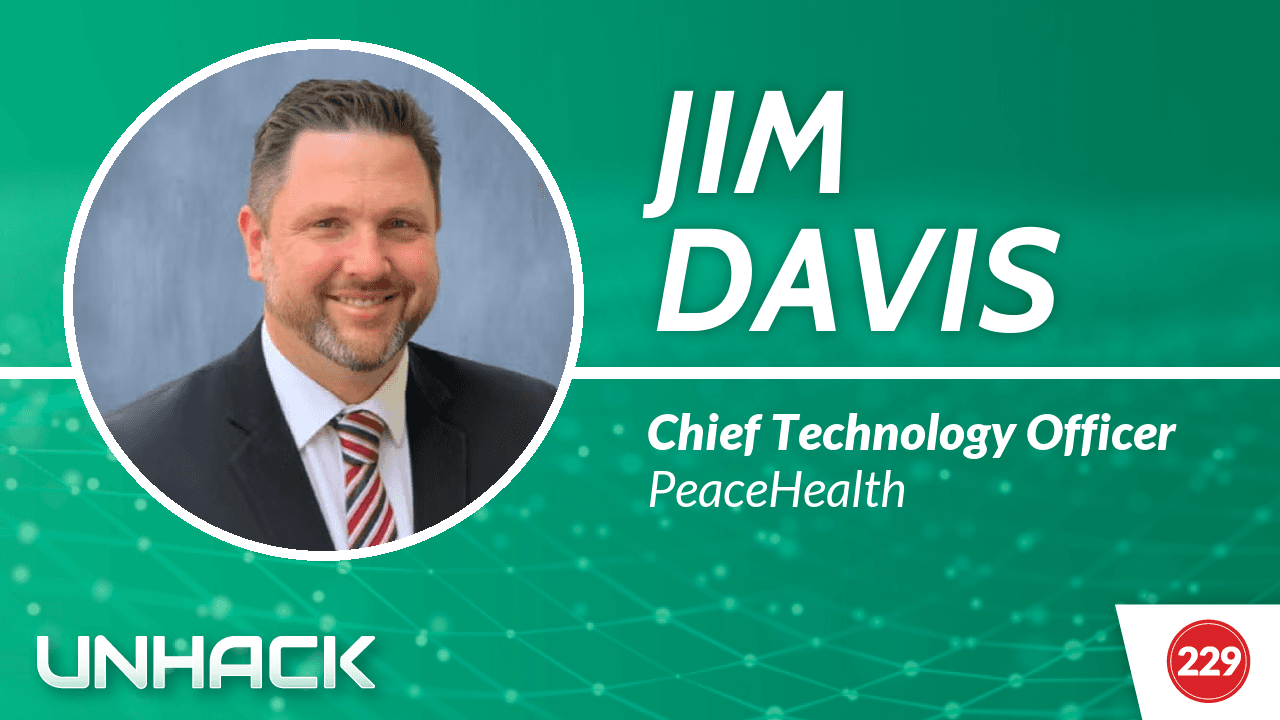
with Julie Eastman and Jim Davis
November 24, 2026: When the Wi-Fi goes down at PeaceHealth, Jim Davis, VP, CTO, PeaceHealth, wants caregivers' phones to keep working on cellular. He is putting in a cellular DAS with all three carriers and standing up five dedicated architects, and he weighs the cost of that second path against the outage. "What does it cost when your caregivers are completely down?" Davis asks Drex DeFord.
"If you can keep your core clinical continuity up and running because you have that backup, you are now the hero," Davis says. Julie Eastman, senior vice president and chief information officer at PeaceHealth, opens the episode with one question for Davis: why is he never allowed to take time off?
Key Points:
Times are on the with-ad file (23:54).
00:05 Julie Eastman
04:50 Fortified Health Security
05:17 Jim Davis
09:08 The CISO Hat
13:00 Five Architects
16:43 Signal in the Stairwells
18:48 The Hero, Not the Pitchforks
20:02 Julie's Question
21:30 Four Vacations
LinkedIn: 229Project
Donate: Alex's Lemonade Stand: Foundation for Childhood Cancer
Drex DeFord 00:06
Hey, everyone. Welcome to the podcast. I've got Julie Eastman with me today. How are you doing, Julie?
Julie Eastman 00:12
Great. How are you doing?
Drex DeFord 00:13
I'm good. How's everything at PeaceHealth?
Julie Eastman 00:16
Exciting. Lots going on. We talked a little bit when I saw you at the regional 229 event, which was really, really a great breakaway for my team. We've been so heads down that they were so grateful to be able to step away and hear what others in our local area were that they were all dealing with the same things. That was, I think, a big takeaway for them. But yeah, we are heads down in the middle of our transition of our IT services to service provider Tech Mahindra, the HCI Group. So we're pretty heads down with that. It's pretty intense and all consuming. So still trying to keep the standard stuff going at the same time as we're juggling all that. So I wonder why spreading some gray hairs, that would explain it.
Drex DeFord 01:12
I've never seen you with gray hair. So I don't know what you're talking about. So as you know, this is kind of the opening for every for a show that I'm a, going to record with Jim Davis, who works with you at PeaceHealth. And it's a direct rip off. I apologize. This is Amy Poehler's Good Hang podcast format. And when I heard it a few months ago, I was like, I should totally steal this because it's a really good idea. So Amy, please don't sue me. It's a compliment. Plagiarism is the most sincere form of flattery. So you're, I want to have a quick conversation with you about Jim. This is your chance to say nice things about Jim behind his back, and it will ultimately be part of the show. But you've known Jim for a while now. Tell me about how you met him and then like how you guys wound up at PeaceHealth together.
Julie Eastman 02:03
Yeah, yeah, I didn't know Jim until I arrived at UCI. I was I went in there as the associate CIO. He, he was part of the panel that interviewed me for that role. And actually, we didn't really see eye to eye right out of the gate. I don't know if Jim would, would admit that. But we, we worked on our relationship. So much so that when I, when I left as CIO to come here to PeaceHealth for the CIO role, he, he was right there saying, I'm, I'm all in with you. So but yeah, it was, it was a bit of a, of a rocky start. It took me, I would say, I would say Jim is, you have to sort of scratch below the surface to get to know Jim a little bit and to really appreciate how smart he is and how good at what he does he is. So it did take me a minute when I first got there. But we, we developed a strong respect and a great relationship. As soon as we, we, we crossed that bridge.
Drex DeFord 03:14
It's funny. I had a guy like that who tagged along with me named Wes Wright, who was with me in the Air Force, then went me to went with me to Scripps Health and then to Seattle Children's. And so it's great to have those people. You can almost like telepathically talk to them. They, they know just by looking at you, what you're thinking and what's, what's going on. You have that same kind of relationship with Jim.
Julie Eastman 03:39
Yeah. Yeah, I would say so.
Drex DeFord 03:41
I want to give you a chance. This is your chance to kind of step into the next part of the show, which is the interview with Jim. What's a question I should ask Jim during his interview? That will question that will stump him or surprise him that you know about. It can be a question that stumps him or it can be a question that makes no sense to me right now, but might reveal something really interesting about Jim when I interview him.
Julie Eastman 04:11
Yeah. I think you should ask Jim why he's never allowed to take time off. You'll know, you'll know exactly, exactly why I say that. And it relates back to our time at UCI. We haven't had the same situation here at PeaceHealth, thankfully, but, but it'll make sense.
Drex DeFord 04:33
This is good. Okay. Totally. I will. I'll ask them that. Hey, thanks for doing the setup today. I really appreciate it.
Julie Eastman 04:40
And you know, yell anytime, anything I can do. I'm always happy to help.
Drex DeFord 04:44
Of course.
Julie Eastman 04:45
Have a great conversation. Jim's a great guy. You'll, you'll, he'll have a blast.
Drex DeFord 04:49
Thanks.
Announcer 04:50
All right, we're gonna take a quick break. Here's a word from our sponsor.
[Ad read: Fortified Health Security] 04:54
This episode is brought to you by Fortified Health Security, five-time best-in-class. Fortified cuts through the noise with 24/7 threat defense and advisory services, helping health systems strengthen cybersecurity resiliency, protect patients, and defend against threats. Find out more at FortifiedHealthSecurity.com.
Announcer 05:15
All right, let's get back to the show.
Drex DeFord 05:17
Hey, Jim Davis is with me from PeaceHealth. How's it going, Jim? Good to see you today.
Jim Davis 05:23
All great. Great, pleasure to see. Everything. Everything's going well up here in the Pacific Northwest.
Drex DeFord 05:28
Yeah, I'm in Seattle. You're in, you're in, you're north of Portland.
Jim Davis 05:32
Vancouver, right across the Columbia.
Drex DeFord 05:37
You have a really interesting background. You've done a bunch of different and then you wind up in Vancouver. the Tell me the, give me the short story of kind of how this all came about.
Jim Davis 05:51
Yeah. So, you know, going to, going, Um, for, uh, trying to be a physical therapist, uh, way, way back in the nineties, uh, you know, a long time ago, um, realized it wasn't really working out. So as part of the dot, the dot com, uh, air there, I jumped into school and started to focus on some I.T. stuff. And lo and behold, I jumped into, uh, a job, replacing uh, motherboards for Y2K. Y2K. Y2K. Yeah. The big event. So, it came out to be nothing, but I just started to learn more and more during that time. Was blessed to be [unclear: "relenting"] for an organization that threw money at IT. Something we don't hear about very much today, but the more the more that I wanted to learn and the more I wanted to innovate there, they just continued to throw money at me. So from there, just kind of ran ran its course, learn telecom and networking and storage and you name it. And then. I found my way into healthcare and then started to work for Children's Oakland in 2007 and learn even more. Now I'm working for a true healthcare and healthcare IT is much different than traditional IT and a financial insurance agency. So I really learned about true 24 by 7 and the impact that we have when we hit the wrong button in IT. And then from there, just, just started to learn more and more than I could enterprise grade solutions and kind of grew from, from there. And the EMR needed to be upgraded. So I learned how to move from a technical background more into the actual application background and got myself certified with Epic and helped lead a pretty significant project and then from there we either went downhill or up however you want to look at it. I got myself into management, and then, and then from there, really started to kind of apply my skills and helping out, you know, those individuals on my team is remove the barriers, allow them to do the work and help with the political stuff that comes being in management. Transitioned over to UCI In 2015 in Southern California, and then really grew from there. Started as a manager overseeing just Network and Telecom and Storage took over their CTO role a couple of years later and then from there had a wonderful opportunity to bring my family north up here in Vancouver to PeaceHealth where now I'm their system VP and Chief Technology Officer. For nine hospitals across three states serving a lot of patients in those rural areas that don't have very good access to care.
Drex DeFord 08:47
It's a cornerstone of the communities that you are in. I mean, I don't, people probably don't say this to you all the time, but like health systems like yours. There's a lot of people in those communities that like if you're not there, they don't get. You know, they don't, they don't have anything. So, thanks for doing that. Thanks to PeaceHealth for doing that. Now, if I remember right, when we were together in Portland for regional staff round table, we had a conversation about maybe you're also kind of holding the fort on the Chief Information Security Officer job too right now?
Jim Davis 09:22
We don't have a true CISO here. So I'm wearing that hat, you know, as some CTOs do most organizations. So as we are growing and you know just kind of getting ourselves more modern here at PeaceHealth, I took on I took on that role. I'm not not a CISO by trade but I've done enough in the security side and partnered, that I'm okay at it, and I always have that lifeline to those CISOs that I know very well. I can ask, hey, what would you do in this situation?
Drex DeFord 10:00
And that's always great. What a wonderful community. You know, your CTO and your CISO group. It's great, great to have them on speed dial. They, I mean, it is, these are just like your, I have a lot of folks who kind of of say like, like they have their own board of directors now. So like when something's going on, I send an email to 25 people. That I've been in summits with or something and I get, you know, 23 of them reply to me immediately with with what's happening. That community is actually super powerful. I've not been a CISO either. You know, I've been a CIO my whole career. I've always had security responsibilities, but you know, like I only kind of I play a CISO on TV. It's a, it's a, you know, it's a, it's a super complicated job. And so the folks that do it I'm super thankful for them too. They have a really hard job. The CITSO kind of thing, Chief Information Technology Security Officer, thanks to Steven Ramirez for giving me that that lingo. But the CISO job has become a thing more and more, I think, across, across the country. More and more folks are kind of creating those roles. Some of that's to deconflict some of the things that happened between. Security operations that wind up in the CTO's department, and the policy stuff, and risk conversations that happen in the CISO department.
Jim Davis 11:22
Agreed, Yeah. It's, you know, I, I've met a few that are in that, that CISO role as well. And it's, you know, it's interesting. I look at it as, I think that there, as you stated, it helps to remove a lot of the barriers that have been there traditionally where you butted heads, or just can't move forward. I look at it as a conflict of interest potentially as well. But as long as long as I am being honest, and upfront with everybody, it does help to remove potentially that stigma that, hey, I'm controlling one side and the other. the peace that could potentially cause harm or good in the organization. But at the end of the day, I'm being paid to ensure that we're safe and that we're delivering those solutions that deal with patient care. So I take it as a challenge. But I always again, I always look to. Reach out to all of my colleagues there, and you know, thanks to 229, we've been able to do that even more here in the Portland regional area. I now have that many more colleagues that I can reach out to in the healthcare community to say, hey, what are you seeing? What are you doing here? As we're under attack, under threat, and under constant change. It's always good to have that lifeline to call. On a daily basis, if needed.
Drex DeFord 12:44
Yeah, it's great to bring everyone together for these 229 project events. What's happening? What's exciting? I think you've got a lot of stuff going on, so I'm just going to leave that with you now. Tell me what's going on.
Jim Davis 13:00
Very busy here at PeaceHealth. We've got a lot of organizational change that is occurring here, a lot of major projects occurring across all the facilities. But the one thing I'm really excited about is being able to really start a true architecture group here. And historically, it's probably seen in most healthcare. Facilities is wearing multiple hats, and as part of this change, I've been able to identify a few of those, you know, key leaders here and say, hey, we need you in an architectural, we need to pull you out of operations and we need you to focus on the demand that is coming from the organization and help us identify what. What can we do in addressing the business needs? And how do we start to deliver those as well as enhance the services that we have today? You know, we're always going to have life cycle replacement strategies, but what are the things we we should be adding on to that that benefit the organization. So being able to now have access to five dedicated resources who at their sole focus is true architecture and innovation. It just excites me. It's something that I haven't been able to really play with before in other organizations that I've worked at because it's always been taboo to, you know, have architects within the department. It's always, hey, lean on your partners, let the business determine, and we want to partner with the business to help deliver the solutions, not have somebody, somebody show up with something, and then we have to figure out how to make it work within our organization.
Drex DeFord 14:38
Yeah. The other part of, that for me has always been you have to figure out you need people who aren't pulled into the everyday firefighting to have time to think about how do we build everything, the infrastructure, the application portfolio, the knowledge management layer of our business. How do we build those things in a way So that they are better-prepared for what's going to happen in the future. A lot of times we have, you know, you know, business or clinical research folks come to us and say, we want to do this. And our answer is, yep, we can do this, but we have all this prerequisite work that we have to do on infrastructure and wireless and all this other stuff before we can actually do that. So the project that really should take four months turns out to take 18 months and. A lot of that can be avoided with architecture, right?
Jim Davis 15:32
Correct. Correct. And that's, that's exactly, you know, our focus right now is, is, you know, we've invested millions in infrastructure to it, but you just stated our network needs to be upgraded to be able to then deliver what we consider, you know, clinical communication. How do we put a smartphone in the hands of our A lot of our clinical caregivers to then be able to do things. Well, if I don't have modern access points and I haven't validated that our coverage is adequate in stairwells and all of those areas where you need to receive that phone call, we are knocking through a lot of these prerequisites to then set ourselves up for success when we start delivering handhelds with. Apps on there where you can now call and be able to communicate broadly across the organization, having to walk to. A desk, pick up a phone and place a call. I mean, that's so old. We need to be in 2026 and with smartphones and everything out there, depending upon your choice, The options are endless, and we're very excited to start, you know, getting PeaceHealth to that point where we're delivering better patient care and better outcomes, not only to our caregivers, but to our patients.
Drex DeFord 16:44
I don't want to dig too far into this, but like you said something there, like we have good, you know, reception in the stairwells. And I just think about every hospital that I've ever been to and the reception in the stairwells are terrible and the reception and radiology is terrible and the reception in the basement. is horrible and like, I mean, a lot of this is the reason we saw beepers in healthcare. Sometimes a beeper system is the only thing that works in some of these places. Can you give me a little clue as to kind of like how you rigged that problem I'm sure a lot of health systems still have that problem.
Jim Davis 17:19
Oh, 100%. I'm actually dealing with a pager beeper issue, you know, as we speak. And you know, whether it's workflow, whether it's, you know, transmission, because you're, you know, you're building, you're getting, you know, smarter, you know, LEED, LEED certified so that you can-I can control, you know, what's coming in and coming out. Well, signal doesn't like to go through e-glass these days so We have to, again, architecture has to stay in front. Well, what are we delivering? Let's make sure we don't we don't. cut off access to those critical services. So some of the things we're doing here at PeaceHealth is, you know, a cellular DAS. Let's make companies that really specialize in this and making sure that we have all three carriers. signal pumping through there providing 99.9% coverage across your facility is key And not only is it a backup to your Wi-Fi system, especially when you look at buying those smart phones, you can use cellular or Wi-Fi, But think of the patients, you know, when they're trying to communicate with their loved ones and family. If you're in the cafeteria, you're outside of that MRI suite and you have no connection, You communicate as to what's going on. So it is essential. It is table stakes these days to have those levels of service there across the organization. And that is my job to help fight and advocate for the funds to deliver those services across all of our facilities. man.
Drex DeFord 18:48
The other part that you say there that kind of really rings a bell for me is the if Wi-Fi goes down, I've got cell like the resilience. also that happens because of what you're doing with cellular DAS is a really kind of big deal. Yeah, it's, it,
Jim Davis 19:03
again, it goes back to the architecture. And so, you know, purpose, purpose-built solutions that are going to be delivered is we need to understand, well, what are our [unclear] doing and how are they using these devices? So everybody has a smartphone today, whether it's theirs or whether it's one provided by the organization. We need to make sure that it's on our Wi-Fi and then it also has cellular connectivity. I understand it comes at a cost, but what does it cost when your caregivers are completely down? Because you've had a VDI issue or, you know, heaven forbid another CrowdStrike issue. If. If you can keep your core clinical continuity up and running because you have that backup, you are now the hero. Instead of the pitchforks and torches, you know, somebody's probably going to carry you through the facility and say, thank you. And that's our job is. ensure we always deliver something with that high availability and that secondary option.
Drex DeFord 20:02
There's so many things we could talk about. I want to tell you something else that's part of the podcast now. So before I talk to you, there's somebody named Julie Eastman. You know her. Julie. Julie's the CIO At PeaceHealth. You and Julie have been around and been hanging out together for a while. Pretty cool story if you want to tell that. But I spent a little time with Julie, before I interviewed you, and I asked her to, you know, say some nice things about you behind your back, and she did you behind your back, and she did a really good job. And so when you watch the show, you'll be able to hear that. But one of things I do is I ask, I ask the person I interview up front is what's a question I should ask the guests today. So what's the question I should ask Jim? And so her question was for me to ask you, why are you not allowed to go on vacation?
Jim Davis 21:08
Oh, this goes back to the whole CISO [unclear] conversation. So, uh, so I. I'll you know, Julie, Julie and I met when I worked at UCI. She came in as the associate CIO and then, and then took over as a CIO.
Drex DeFord 21:25
Did you guys get along real well right out of the gate?
Jim Davis 21:30
You know, it's funny. I thought she was in my business. And so I wouldn't say it was contentious, just for that, you know, a little guarded, when she came over, but. We quickly figured each other out and, you know, here we are today. I followed her up here to PeaceHealth and then reported to her. But I have gone on vacation, I think four times in the last three years. And each time that I have gone. Uh, there has been a significant event that has occurred. And so I am no longer allowed to leave on vacation. I am stuck to this chair in my office permanently because when I leave, there is a significant event that happens and then Julie is looking for me. And guess what? I'm on vacation on an island, somewhere without cell reception to be able to solve the issue. So yes, it is a, It is now a joke that I'm no longer allowed to leave.
Drex DeFord 22:25
I'm sure she's going to let you actually go on vacation now, right?
Jim Davis 22:29
She She does. But generally, there's a leash. And you know, if I had to, I would probably start carrying satellite phones so she could truly say you're
Drex DeFord 22:39
You're never completely disconnected. It's not like you're in the stairwell outside of the MRI suite.
Jim Davis 22:49
It's funny. Being in IT, I should probably just get myself a little personal Starlink that I just carry with me everywhere. And I can work whenever I need to.
Drex DeFord 22:57
I carry, I mean, I have one. I carry it with me, you know, kind of everywhere. I go. It actually works great. I put. I put it in the window of the pickup truck, even when I'm driving. I have my own little, you know, Wi-Fi running all the time. So, yeah, that might be a thing.
Jim Davis 23:14
Hopefully she doesn't see this and then say that I need to go get one of those so that I can, I'm always on.
Drex DeFord 23:21
So yeah, I appreciate it. Hey, it's always great to talk to you. Um, it's. Always a ton of fun and, um, man, there's so many things we could talk about, but there's also only so much time. Let's do this again, uh, sometime soon, and I'll see you, uh, I'll see you out there, uh, as we're traveling around the country.
Jim Davis 23:38
Yeah, absolutely. Drex, it's been a pleasure. Happy to be here. And you know how to get in touch with me. I'm always a phone call away for you as well.
Drex DeFord 23:47
Thanks very much. I'll talk to you soon.
Keep exploring
UnHack the Podcast · Oct 27
UnHack the Podcast · 19 min listen
UnHack the Podcast · ~46 min listen
UnHack the Podcast · ~43 min listen
UnHack the Podcast · ~36 min listen