

 Apple Podcasts
The 229 Podcast · 40 min listen
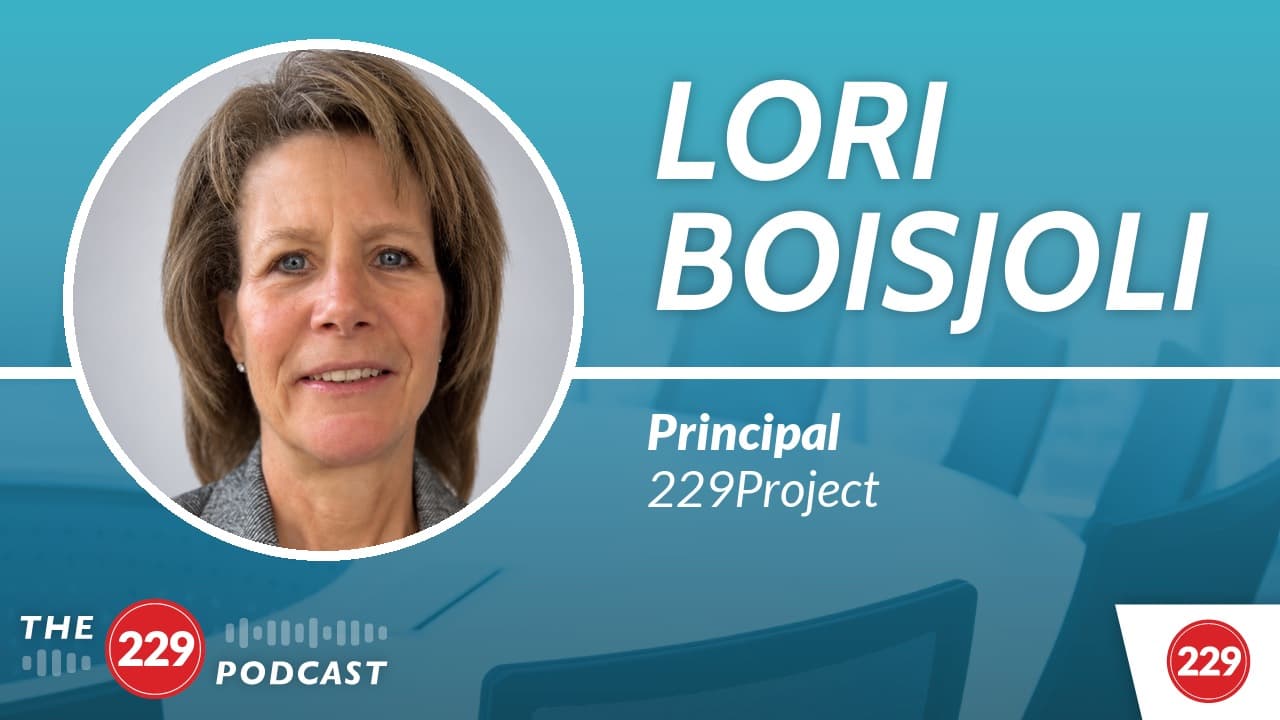
October 22, 2026: Lori Boisjoli has sat at 229 tables as a CIO. Now she is joining 229Project as a Principal, and this conversation with Bill Russell is her welcome to the community. She learned BASIC in high school, took a coding job at IDX in Burlington, Vermont, and soon decided she could not just sit in a cube. She later became CIO of the six-hospital University of Vermont Health system, which went through a cyber attack nearly five years ago. Other CIOs still ask her to share that experience with their executives, sometimes to "scare the hell out of our C-suite."
Now she will host those tables, and she wants each room to leave with more than a takeaway: if a group agrees AI belongs in contract language, she wants that group to propose the language. That instinct goes back to Sharp HealthCare, where she spent the better part of nine months building the hospital side, and the team threw her a baby shower for her firstborn. "It is about the relationships," Lori said. For members, that means a host who was recently in their chair and wants every session to give them something they can use.
Key Points:
0:00 Welcome, Lori
1:03 Atlanta and the resilience panel
3:52 Restore by service, not by tier
5:07 Sharing the story with other C-suites
7:01 AI before joining 229Project
9:25 Agents that work while you sleep
11:31 Carve out time for innovation
12:53 From IDX and Allscripts to the provider side
16:27 "It is about the relationships"
19:20 What she hopes to build with members
21:08 Hosting the room
Donate: Alex's Lemonade Stand: Foundation for Childhood Cancer
This transcription is provided by artificial intelligence. We believe in technology but understand that even the smartest robots can sometimes get speech recognition wrong.
Welcome Lori Boisjoli, 229Project's Newest Principal
[00:00:06] Bill: All right, it's the 229Podcast, and today I am joined by Lori Boisjoli, the newest principal for the 229Project. So you're, you're joining us. Lori, welcome! Welcome to the show, and welcome to the team.
[00:00:21] Lori: I am so excited to sort of start this next journey and be a different part of the 229 community.
[00:00:28] Bill: Yeah, I'm looking forward to it as well. I mean, when we had the conversation and I found out that it was a possibility, I immediately went to my advisors and said, can I hire Lori, please, please, please, can I hire Lori? And they were all like, absolutely, so I'm looking forward to it. I think people think I run this thing by myself, but there's a host of characters behind the scenes.
[00:00:52] Bill: That are helping me make decisions, and I am so glad that you're a part of it. You've actually started participating. Where were you at? You were in…
[00:01:03] Lori: Atlanta.
[00:01:04] Bill: Atlanta. Oh, and I did not make that, because I had COVID. How's that for leadership? I send you to Atlanta, I don't even show up. You were on the resilience panel. What was that experience like?
[00:01:19] Lori: Well, for me, you know, I mean, it's not a secret that nearly, 5 years ago, was it? We had a terrible cyber attack, at University of Vermont Health, and so…
[00:01:32] Bill: yesterday, doesn't it? Yes.
[00:01:33] Lori: So that topic is near and dear to my heart. So, you know, when you unfortunately weren't there, you know, and it was Drex and I, and he said, you know, what can you do? And I said, I'm happy to lead, you know, that conversation, and I actually started it by kind of telling, sort of.
[00:01:52] Lori: you know, our story a little bit, and then, you know, it led right into the panel discussion, and it was, you know, sort of very easy, and I think some of my, probably, background on the
[00:02:05] Lori: partner vendor side, you know, and sort of leading focus groups and those kinds of things make, you know, that part sort of easy and fun, and kind of one of the things I look forward to, in this next journey.
[00:02:48] Bill: Yeah, it's interesting, when we tell those stories, just a, of the actual breaches. I know that we've heard some of those stories at our summits, because they're smaller rooms, 15 people rooms. We've heard, very detailed stories. We heard detailed stories from Lurie Children's, we heard detailed stories from…
[00:03:12] Bill: From Scripps as well, and when people hear them, they go, oh, oh, I didn't realize that. Oh, oh, I didn't realize that either. I thought one of the more interesting things, and I've heard it from you, and I've heard it from Scripps as well. I said, what's the first thing you brought back up? And, his comment was.
[00:03:31] Bill: well, you know, we did all this great planning, but you might as well just throw it out. I mean, because it's like, all of a sudden, we're like, hey, these are the first apps we're going to bring back up, and then you get into it, it's like. oh my gosh, you gotta bring oncology back up, like, immediately, because, like, we can't treat these patients, and, like, this is… this is urgent, we have to… and, I think you guys had that… a similar kind of experience with that.
[00:03:53] Lori: Yeah, we did, you know, like, we had, like most organizations, applications, you know, tiered, right? So we had our core, our gold, our silver, bronze, people might call them, you know, something a little bit different, but it's really, you know, primary, secondary, tertiary, and, you know, that was our plan. But you don't bring apps back based on that plan, you bring them back exactly like you said. service.
[00:04:18] Lori: And so, when you want to restore oncology, because that was our most critical, you need 3, you know, three of the primary, two of the secondary, three of the tertiary, and you… it's a service, and we hadn't thought about it as a service. You know, the…
[00:04:40] Lori: potentially good news for us was we had to rebuild infrastructure, so while we were doing that, the CNIO and others were figuring out, sort of, what was in those lines of service, and, you know, we kind of came together at the right time to move that forward. But, you know, that's… we call it, our cyber attack, the gift that keeps giving.
[00:05:04] Lori: Because we continue to have these conversations with organizations. I have you know, Hal Baker call me up and say, Lori, can you scare the hell out of our C-suite? And I'm sure I can, and so, you know, a few of us get on a call and talk about it, and then we have others that say, you know, we're talking about business continuity, can you come, you know, sort of share with us
[00:05:27] Lori: And sure, and so I've done, you know, a bunch of that with Buddy Hickman and Hal and others.
[00:05:34] Bill: Well, I'm trying to think of the acronym for scare the hell out of our C-suite. It's like, if we could come up with a… if there was, like, a… if that, like, spelled a word, that would be a new service that we offer at the 229Project. Give us a call, we'll come in, scare the hell out of your C-suite. And, you know, to a certain extent.
[00:05:53] Bill: the organizations that have experienced it, it does become a gift, because they have a perspective. I did ask a couple of the organizations that had gone through it, and I said, you know, there's no education we need to do anymore. Like, they experienced it, they went through it, and…
[00:06:11] Bill: You know, every now and then, they'll have to remind people of, hey, hey, you know, this, but for the most part, it's like, this is part of your… part of your experience, shared experience now, and it's like, now you have people asking the CIOs, like, hey, is, is this secure? Is this gonna… you know, is this…
[00:06:32] Bill: Yeah, it just, it just changes things. I don't want to spend the whole time talking about this, because you're going to have PTSD if that's all we do. Eventually, so you and I will be going to Boston next week, we'll be going to Charlottesville, and doing our regional staff roundtables. We do two, panels. We do the,
[00:06:53] Bill: We do the resilience panel, and that's, that's fun, and you'll probably get to do those again. But we also do one on AI. I'm curious what your experience was with AI, up to the point of joining us at the 229Project.
[00:07:11] Lori: Yeah, I would say, you know. prior, sort of wearing that CIO hat, we were, dabbling. We actually, I think, had been in a pretty good spot. We ran the head-to-head on, ambient listening, and that actually got a lot of, sort of, you know, press and talk.
[00:07:32] Lori: And eventually, you know, landed on Abridge and have a really good relationship, you know, with Abridge as a result of it. But, you know, that was a time and place, and they just kept going, you know, this one would advance, and this one would advance, and so, you know, I honestly don't know that exact landscape today, but, you know, it was all of those pieces, certainly mostly in
[00:07:55] Lori: sort of the partner space, and, you know, what they were bringing forward, Workday, you know, all those kinds of things. We weren't doing a lot, ourselves, besides, you know, those of us sort of playing with what
[00:08:11] Lori: co-pilot and, you know, the LLMs could do at the time, and it was more, you know, sort of question, answer, help me build a response, help me fix my grammar, like, all those kinds of things, you know, and I would very often, you know, as, the CIO of a six-hospital, healthcare system, I need to, you know, and it would help me, but now it's…
[00:08:34] Lori: you know, evolving to so much more with agents and sort of those capabilities. I'm actually kind of excited to sort of get back in and have, like, real, like, work experiences around it. You know, I mean, I built a little recipe app and, you know, some of those things on my own, but, what it does for me, sort of.
[00:08:55] Lori: Personally, will be very different than what it can do for me professionally.
[00:09:26] Bill: Well, you'll get your, you'll get your Grok Bot invitation after this, after this conversation. it's my newest, direction, and the biggest difference, people are like, Grok, why are you going with Grok when this is better and this is better? I'm like, they're… they're all sort of, they're all sort of good enough now, and the question is, you know, when you need something like Astra or…
[00:09:49] Bill: or Fable, you can go to those and ask them these massive architectural questions and that kind of stuff. But for the most part, the stuff we're doing day-to-day, we're finding that the… that all the models sort of can answer your… first of all, they can do the search and retrieve and find stuff. I… I ask it now, hey.
[00:10:10] Bill: you know, there was a… you know, there was an earnings report yesterday, go out and find this transcript for the earnings report. Okay, got it. Great, you know, what were the key points? Every model can sort of do that, today. The reason we're playing with Grok Bot is the Agentic aspect of it.
[00:10:30] Bill: that it actually does work for you while you sleep, or while you're in meetings. And boy, as a CIO, I can't think of a better thing than knowing that, yeah, I just got stuck in a, you know. 4-hour strategy session, which is fantastic, but when I'm done, I don't have to work another 2 hours.
[00:10:50] Bill: Because it's just going to tee up everything I need to do. It's like, hey, you got this email from Lori, she wants this, do you want to respond? And just go, yeah, that's a great response, go ahead and send that, this is good, whatever. And it's almost like we have a… we have a whole team available to us now with these agents. But man,
[00:11:12] Bill: I think about it from the CIO's chair, and the challenges it sort of brings to the table. I mean, what are your thoughts? Is this coming too fast at the CIOs? Is there just too much of the daily basic blocking and tackling to even get in front of this stuff?
[00:11:31] Lori: it… I mean, probably depends, right? We have a lot of organizations that are sort of, you know, always been kind of the leaders. And, you know, have been sort of at it longer. But this is one of those that you can't ignore. And, I read an article not too long ago, and I forget the exact quote, but it's…
[00:11:51] Lori: you know, the gist of it was, you really have to carve out time for innovation. It can't be the next… it can't be, like, in addition, right? Like, you have to set aside, sort of, some time to play with it, to understand, to ask questions, to whatever it is, and if it's just gonna be the what you do on Saturday morning, or whatever, and that's really hard, right? You're in these meetings, you're in
[00:12:16] Lori: all of that, so if you can, instead of spending, you know, the two hours after that 4-hour stress strategy session, you know, if you can carve that down to 30 minutes, because you've got, you know, an Albert-like
[00:12:30] Lori: agent working for you, then, you know, take that other time and, you know, see what else is possible. And as, you know, the CIO, not only our IT teams, but certainly, you know, our peers. You know, they look to us to help them understand what is possible.
[00:12:53] Bill: Yeah, it's gonna be interesting. So, you had a job before, University of Vermont. Give us a little bit of your background, so some people might not know your background.
[00:13:02] Lori: Yeah, I actually grew up, on the vendor partner side, always in healthcare. I'm old, so when I was, in college and got a computer science degree, I can say there were not a lot of other people that looked like me. But, you know…
[00:13:21] Bill: So, just to get an idea of how old, did you learn on punch cards, or did you learn… No. Okay, so you're not that old, because my.
[00:13:30] Lori: No, but it…
[00:13:31] Bill: My first class was on punch cards.
[00:13:33] Lori: Yeah, no, I never had the punch card thing, but, you know, I mean, I took a… learned to do basic in, you know, high school, and that's what sort of hooked me. I was like, wow, this is kind of fun. And so, I went in the direction of a computer science degree and thought I would, you know, mostly code. I started at IDX, which is a big healthcare company.
[00:13:56] Lori: In… Burlington, Vermont, and coded for a little bit, and then kind of said, I can't just sit in a cube. Just my… I wanted to be more outside and, you know, involved in more things, and so I really went more in the product
[00:14:16] Lori: management direction and requirements gathering, because then you had to have people to do the requirements gathering and, you know, ran a lot of, you know, focus groups and those kinds of things, and I was at IDX for a really long time, and, got bought out by GE, and I…
[00:14:36] Lori: saw what was happening and, you know, sort of the… it was not what it used to be, and so I went from there and, burned a non-compete in a,
[00:14:48] Lori: a water company space, and just didn't hold my interest, and then went to Allscripts, and spent a good amount of time at Allscripts, and that's where I, you know, really came to know Hal and Buddy and folks like that, and, did that for a long time, and then, decided I had, sort of.
[00:15:10] Lori: done a lot there, but I was traveling, and what could I do back, sort of, home, closer to home, and how could I take what I had learned, and opportunity came up at University of Vermont. They were gonna… deploy Epic across all the hospitals. It was a part of it in, you know, the academic medical center, and…
[00:15:32] Lori: So, started on that path, and then grew from there.
[00:15:36] Bill: Wow. So, I'm surprised we didn't run into each other. We were a, we were a big Allscripts customer, and we were a big, GE IDX customer. It was not my favorite… part of my job, You know, I always… I always liked Allscripts. I thought they were heading in the right direction, but,
[00:15:57] Bill: But they were just… they didn't have an acute care system, so within our health system, it just became a extremely limiting factor to have a different ambulatory and acute.
[00:16:11] Bill: system, and I think that's… that's what happened to a lot of the EHRs. Like, if you didn't have both sides equally as… as strong, then, then the alternatives Tended to, select themselves.
[00:16:27] Lori: Yeah, I mean, but great leaders have come from that. Look what Glenn Tolman is doing, Lori McGraw, you know, sort of all have, you know, really gone on, and, you know, I think about it with, you know, a ton of warmth in my heart to… I spent a lot of time at Sharp Healthcare. They actually, We were only in the physician space.
[00:16:49] Lori: And so they took a chance on us on the hospital space, and so I actually was out in San Diego you know, probably 9 months of my life, you know, back and forth, sort of building what we did there with Bill Spooner and others, and, you know, just to this day, even have, you know, great relationships. They had a
[00:17:08] Lori: baby shower for me with my firstborn, and, you know, and that's what's… that's what this whole job is about, right? That's what, like, 229 is, you know, so important to me, because it is about the relationships.
[00:18:00] Bill: Yeah, so, I mean… Look, we, we, we have, we have a phenomenal community. We just… you know, I feel like every week I could talk about a different group we got together and conversations. Today, as we speak, there's a regional roundtable going on. It's today, Wednesday. No, yesterday was the Kansas City Regional Roundtable, and tomorrow is the LA Regional Roundtable, and
[00:18:25] Bill: you know, I'm looking at the surveys and the responses people give to us, and they're like, thank you, thank you, thank you, like, this is so necessary. And it's not that we need another meeting, but what we try to find is those spaces Where, certain groups don't have the opportunity to get together, and these regional meetings tend to really
[00:18:46] Bill: meet a need that is there for the, let's say, the CISOs to all know each other, and the CTOs to all know each other, and the CNIOs and CMIOs. When they sit across from each other and just start talking and having those conversations, it's… it's really… it's… it's…
[00:19:04] Bill: really fun to see how things move forward and what they decide to do. You know, we come in, have the meeting, and we leave, and then we hear about, yeah, they're getting together on a quarterly basis, and have continued those relationships, which is fantastic. What do you hope? I mean, what's your hopes as you come on board with, the 229Project. The, you know, we… we are…
[00:19:28] Bill: We will finish this year… well, actually, we don't have a lot of travel through the end of this year. It's, like, next week, and… And the, the New York, the New York, dinner, and that's about it, but you're not even going to the New York dinner. I mean, your, your schedule really doesn't start until, until January. But what, what are your hopes as you, as you get involved?
[00:19:53] Lori: I mean, I think, for me, it's…
[00:19:55] Lori: You know, I sat at that table in a number of, the sessions previously, and so just being on the other side, trying to facilitate those relationships, hearing about something, and saying, you know what, you should talk with so-and-so, or, you know, just trying to sort of bring forward those learnings and spread it wider, I would hope that we actually
[00:20:18] Lori: Rather than sometimes just, sort of say the takeaway is you should, you know, make sure you've got you know, AI covered in your contractual language, you know, as a small group, can we propose, you know, language or something? You know, like, actually try to continue to make that CIO job easier by, you know.
[00:20:43] Lori: Supplying, connections, info, data, whatever it might be.
[00:20:49] Bill: Well, it'll be… I'm looking forward to you hosting these meetings. What we've found is, the host… has different styles and different approaches. So, you know, we say Drex, you know, Drex just makes everyone feel great.
[00:21:07] Bill: And… and really just encourages the group to come up with the answers. Sarah is just so encouraging, it's fantastic, and the reputation I've gotten is…
[00:21:19] Bill: encouraging to a point, and then pushes a little bit, like, hey, you can do more, and I blame my mother for my upbringing for that, but it'll be fun to see as your style and your… and I think your closeness to being in that chair is really going to,
[00:21:38] Bill: really gonna benefit the communities that you host and bring together, so… looking forward to it. Lori, welcome on board!
[00:21:45] Lori: Thank you, so looking forward to it.
[00:21:48] Bill: Alright, everybody, thanks for listening. That's all for now.
Keep exploring
The 229 Podcast · Oct 15
The 229 Podcast · 40 min listen
The 229 Podcast · 22 min listen
The 229 Podcast · 55 min listen
The 229 Podcast · 42 min listen