

 Apple Podcasts
The 229 Podcast · 23 min listen
32:10
with Lori Boisjoli, Sheree Mcfarland, Susan Ibanez, Ken Buechele, Andy Draper, Carla Haack, Tom Balcavage, Lisa Johnson, Rick Leesmann, Jason Fischer, Gina Sulmeyer, Renee Fosberg, Kristin Seubold, Sheri Strobel, Sissy Schilling, Thomas Bartiromo, Deborah (Debe) Gash, Ross Younger and Kate Bakich
The outage at Southeast Georgia Health System lasted 21 hours, and the impact lasted three days. At Emory Healthcare, staff who didn't know what to do with a paper chart put it in a locker and called digital to ask. Dr. Carla Haack traces it to how good Emory is at upgrades: "that means we have very short downtimes, and that means that we suck at doing downtime."
Health system IT leaders worked the same problem on stage at our Regional Staff Roundtables in 11 cities, with their own teams in the room. Gina Sulmeyer, MD runs drills across night and day shift, Lisa Johnson found NICU nurses who can't do the math Epic does for them, and Sheree Mcfarland's team watched competitors take critical patients during Hurricane Milton. "The further you get from that time zero, the less confident I am," said Ross Younger, CIO at Riverside Health System.
Guests (order of appearance)
Dr. Carla Haack, VP of Financial and Perioperative Informatics, Emory Healthcare
Tom Balcavage, SVP and IS&T Chief Operating Officer, Jefferson Health
Susan Ibanez, CIO, Southeast Georgia Health System
Jason Fischer, CIO, PIH Health
Drex DeFord, Principal, The 229Project
Ken Buechele, CIO, Eisenhower Health
Gina Sulmeyer, MD, CMIO, Torrance Memorial Medical Center
Renee Fosberg, SVP and Chief Digital Officer, Emerson Hospital Health System
Kristin Seubold, Regional Vice President and CIO, Skagit Regional Health
Lisa Johnson, VP of Clinical IT Solution Delivery, Providence
Sheree Mcfarland, CIO, West Florida, HCA Healthcare
Rick Leesmann, CIO, Sky Lakes Medical Center
Sheri Strobel, CIO, Chapters Health System
Sissy Schilling, CIO, Moffitt Cancer Center
Thomas Bartiromo, CIO, Tower Health
Debe Gash, CIO, Golden Valley Memorial Healthcare
Andy Draper, CIO, HCA Healthcare
Ross Younger, CIO, Riverside Health System
Kate Bakich, Deputy CIO, UVA Health
Lori Boisjoli, Principal, The 229Project
Chapters
0:00 We suck at downtime
1:41 The first 30 minutes
6:53 What practice still misses
11:29 What the software knows
16:32 Who owns continuity
17:34 Who shows up
21:12 The single point of failure
25:32 How far from time zero
29:22 What they carry now
30:47 Have each other's back
LinkedIn: https://www.linkedin.com/company/229proj/
Donate: Alex's Lemonade Stand: Foundation for Childhood Cancer
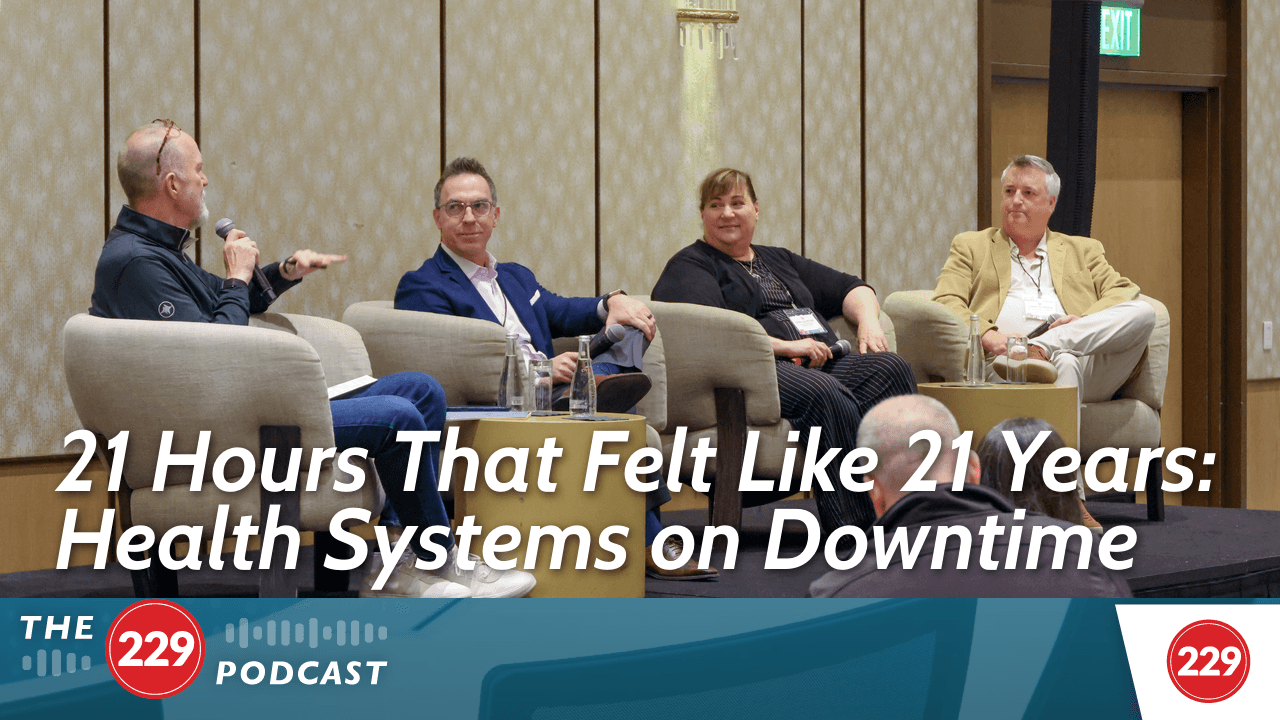
21 Hours That Felt Like 21 Years: Health Systems on Downtime
229Podcast transcript. Timestamps are on the final with-ad clock (32:09.76). Intro and outro stingers and sponsor slates are omitted.
[00:05] Dr. Carla Haack: We realized that we had people who didn't know how to write orders on paper. We realized that we had people who didn't know how to read cursive. We realized that we had a lot of people who didn't know what to do with the paper chart. And they stuck it in their locker or they put it in a filing cabinet in their supervisor's office. And then they were calling us in digital to ask us what to do with the paper chart. We're digital. What do you want me to tell you to do with the paper chart? And I think that that was eye-opening to us. I think that we realized that we may, you know, we're really good at doing upgrades, and that means we have very short downtimes, and that means that we suck at doing downtime. We don't, we're not good at it. We're not good at it at all. We realize we do that all in the middle of the night, and therefore night shift knew what to do a lot better than day shift knew what to do, and that was sort of a, you know, a thing we can plan for and something that we learned from those conversations. I think that we had a lot of really good communication happening within groups and we had a lot of opportunities to communicate better among groups.
[01:12] Narrator: That's Dr. Carla Haack, VP of Financial and Perioperative Informatics at Emory Healthcare, at our regional staff roundtable in Atlanta. Emory got so good at fast upgrades that paper turned into a foreign language. In 2026, we ran that same resiliency conversation in 11 cities. Health system IT leaders on stage, their own teams at the tables. Here's what those rooms figured out, one problem at a time.
[01:41] Narrator: Start with the first 30 minutes, before anyone knows how big the problem is. In Philadelphia, Tom Balcavage, SVP and IS&T Chief Operating Officer at Jefferson Health, runs two tracks at once.
[01:55] Tom Balcavage: Yeah, so in the first 30 minutes, I always think about it as two separate tracks. One is that communication track where we're getting the notice out, IT is aware of an issue, we're working on it, on the technical cyber track, we're pulling our folks together, We're assessing the situation, scope, depth, breadth of the problem, and then bringing our resources to bear there. As we go forward in the process, first hour, second hour, it's deepening that communication to our stakeholders. In many cases, we do have our full emergency communication systems up and running. We have them out of band in case they're reliant on our network.
[02:43] Narrator: Susan Ibanez is CIO at Southeast Georgia Health System. In June 2024, her whole house went down. No attacker. Same damage. She brought the timeline to Atlanta.
[02:55] Susan Ibanez: So the story I was going to share that Lori and I talked about as we were prepping for this was we called it a code black. It happened in June of 24. It only lasted for 21 hours but felt like 21 years. and it wasn't caused by a cyber attack but the impact was really the same and so we could learn a lot of lessons from that that we would use in a cyber attack as well. It was a technical failure that resulted in full system downtime across the house. We didn't have to divert patients but in talking to Chris Christou my technology director you know what he said is the things that we determined in the first 30 minutes helped us figure out what to do during the one hour, four hour, 12 hour, 24 hour, and the ramifications that we felt lasted three days. So the actual incident was 21 hours, the impact was three days.
[03:52] Narrator: Jason Fischer, CIO at PIH Health in Los Angeles, runs exercises every month. They keep turning up the same two problems, and neither one is technical.
[04:02] Jason Fischer: It depends on the event, but we do have a cyber incident response plan or an incident response plan that we do follow. So that first thing is, is it's very important that the folks that are involved in that and leading that need to understand their role in responsibility. We have found through monthly exercises that we do that individuals, Number one, don't necessarily understand their role, and that's important to us to make sure that we're prepping for the punch in the face. And two, even if they do understand their role, they're not exercising their leadership authority to speak up during an event. So first 30 minutes, it's number one, identifying what's going on. What is our impact, right? We can't do anything until we know exactly how we're impacted. In terms of escalations, from me to others in the organization, I may do it, but I'm not going to be specific about it until I have the information that I need. And so there's a lot of pressure on all team members to make sure that we're doing our part and everybody's understanding what their role is to report back into a centralized structure that we may have, and that centralized structure may not be the full centralized disaster structure. it might just be within our IT organization. So that report back is really important. We have, depending on the severity of the issue, there's a time-specific report back. And then once we consolidate the information to then bring something back to the business, either the entire business, a portion of the business, a subdivision, whatever it is, we can be more specific about what do we think is impacting us, length of time, just information that questions that they're going to ask. So, we're really trying to address the questions before they're asked.
[05:52] Narrator: Drex DeFord has a cure for the rumor mill.
[05:54] Drex DeFord: The calm part of this turns out to be really incredibly important, right? What I've sort of discovered over time, too, is that if you say, kind of, here's where we're at, and we're working on it, and if you leave it at that, the rumor mill goes wild at that point. People start making things up. But if you say, we're going to be back on this channel, whatever it is, the team's meeting or the bridge call or the whatever it is, we're going to be back in 30 minutes. We're going to give you an update that calms people down so much, doesn't it?
[06:30] Sponsor message (EHC Consulting): This episode is brought to you by EHC Consulting. If your team is weighing public cloud for your EHR, EHC should be on your radar. Their founding team worked on Microsoft's Epic on Azure Center of Excellence, and they bring that expertise to future-proof your EHR. Find out more at EHC Consulting.
[06:53] Narrator: Then there's practice, and what it still misses. Ken Buechele, CIO at Eisenhower Health, doesn't invent his tabletop scenarios. In San Diego, he explained where they come from.
[07:05] Ken Buechele: One of the things that we do at Eisenhower that Jeremiah who's here leads is that we really, we take the incidents that occur in the real world or even the near misses that we have and those become our monthly tabletop exercises, right? And so we sort of reuse those as those sort of playbook and talk the teams through like, what would we do? What would we do next? and those things really have helped us sort of navigate this sort of unique space that we're in.
[07:33] Narrator: Gina Sulmeyer, CMIO at Torrance Memorial Medical Center, found her weak spot on day shift. So she runs the same drill twice, on the same day.
[07:43] Gina Sulmeyer, MD: We do a night shift drill and we do a day shift drill, and we do the same one and everybody walks through a checklist of their exact emergency procedure. This is a really important thing because when we talked about this earlier, the nighttime drill. This is a thing that we've always sort of known. We take our regularly scheduled down times at two o'clock in the morning. So if you wanna know how to run the... One of the units at night when we have a down... That person knows how to do business continuity. Go to that unit, talk to that charge nurse, they've got it figured out.
[08:21] Drex DeFord: Day shift, though, has always been, for a lot of people, the giant mystery. I don't know how we're going to do this on day shift, so we just never do it on day shift. And so the day shift people really are probably the weakest link in a lot of this, but you do day shift. How do you get them there?
[08:37] Gina Sulmeyer, MD: It's all part of the same drill on the same day. So again, they're just a voluntold, but we do it, and then we have preparation meetings for it that we involve all the ancillary departments in leading up to the drill. We do the same announcements for the drill. We'll do an Everbridge announcement for the drill so everybody knows what's going on, and then we'll have a debrief after the drill for all of the departments involved. So everybody knows the processes, but they have to do it. It's really about leadership. And you change the exercise, the scenario every time regularly. We change it every time.
[09:10] Narrator: In Boston, Renee Fosberg, SVP and Chief Digital Officer at Emerson Hospital Health System, doesn't take the downtime packet on faith. Every month, she walks a unit and asks to see it.
[09:23] Renee Fosberg: So what we've worked on this year is doing rounding in the area. So every month we visit an area and we basically audit. Show me what you do when the system is down. Show me where your computer, turn it on, does it print? And where's the packet? Open it up. Are your forms there? Because it still comes down to the basics.
[09:53] Narrator: In Seattle, Kristin Seubold, Regional Vice President and CIO at Skagit Regional Health, runs a tabletop every year. Then a real incident put her in a huddle, and she heard something no tabletop had caught.
[10:08] Kristin Seubold: I mean, we do a tabletop exercise a year, and I was thinking about the punch in the face, and I was thinking about the tabletop, and I was thinking about Brian, you know, what you said about what really needs to happen is we need to have more frequent practice down times, because with this incident I was talking about, I sat in on one of the huddles and one of our departments said, well, my down time procedure requires the internet. And I was like, oh, boy, okay, and you know, we've done these table tops and this department has been a part of it, and that's never come up, you know, so it's like, wow, when you're in it, you know, that's when things really come up, and so it makes me I'm sitting here thinking, to your point, like how can we think about these more holistically? We're very inclusive in who's there, but I think, you know, there is a little place, Matt, and so it does feel scripted, and sometimes it's those unscripted moments that are most informative. And for me, it was at our southern hospital, and I happened to be there when this happened, and I was really grateful for that because I got to sit and hear these things and think, wow, okay, we've got to dig into some of these experiences that people are having and and really think about, how ready are we?
[11:29] Narrator: The third problem is quieter: what the software knows that people don't anymore. In Portland, Lisa Johnson, VP of Clinical IT Solution Delivery at Providence, took the downtime question to clinical leaders in Spokane.
[11:43] Lisa Johnson: So when I started talking to the operators and clinician leaders in Spokane, that was the first place we went, as a children's hospital, NICU, et cetera, sat down and we started working with the CMOs and CNOs and some of the folks doing the work on the units. And they said, well, what do you mean? Down for like 72 hours. Like we're only down for like less than an hour. And it made me think, oh my gosh, we're that good. So first and foremost, kudos to all of you. Because they've been able to like live under that guise and they were not aware of what was happening in our environment in healthcare and how many organizations have been impacted for weeks and weeks and weeks. The other thing that was really clear is do you know where your Redbook is? Do you know where your red phone is? And a lot of them had no idea because they haven't had to exercise it because it's been so long, again, because you guys do the hard work of being stable. And then lastly, the other scary thing was this, and it made me think about even, when we think about resilience today, it looks different than it even did 10 years ago, because, or maybe 20 years ago, one of the older nurses said, well, I mean, I guess I actually do have value, because I can actually do those really big, like mathematical equations for that little tiny babe in the NICU, and I can do all those calculations. These newer nurses can't do that because Epic does it for them. And so I'm like, okay, so that means our red books basically have to now have those calculations in it, right? If you have to do it by hand. I mean, so it's even evolving basically as our technology is evolving, where we're more and more dependent on this automation and we don't realize basically the knowledge that we've lost if we don't have connection to it.
[13:40] Narrator: In Tampa, Sheree Mcfarland, CIO for West Florida at HCA Healthcare, has a test for new residents and new nurses. Can they write an order without the system?
[13:51] Sheree Mcfarland: That's so interesting, Barrett, because we have probably the largest GME population in all of HCA in West Florida and our own School of Nursing, Galen, and it's just teaching those graduates how to respond to if we had to go hard down, and do they know how to write orders. We usually find the most seasoned nurse on the floor because they know what to do. But it's again teaching the GME residents teaching teaching our young nurses like the one that I Shadowed at Oak Hill had no idea what to do during downtime, so again, there's such a role for for education and continuous training and Making sure they know what to do because they literally grew up with only technology. They don't even know how to write an order never mind where to find a form for it.
[14:36] Narrator: Rick Leesmann, CIO at Sky Lakes Medical Center, joined after a long outage. When you're the only hospital around, the marks don't fade fast.
[14:45] Drex DeFord: Rick, were you there when the bad thing happened?
[14:49] Rick Leesmann: I wasn't, actually. I got to come in after, and it's quite an interesting perspective that you get from your peers and your staff who lived those experiences, you know? Those stacks of paper. Where are you even gonna source that much paper? Do we have the printers to print? Do we have printer? How does that even gonna work? They're all on the network. That's exactly, so someone's going to Kinko's and they're just gonna print off a bunch of intake forms and then you gotta figure out how to get that back in. But then also, how many pharmacists today know how to write a paper script? Not many, and certainly not many back then. And so, you know, what I'd say there is when an organization goes through something like that, the marks remain five years, 10 years, 15 years, because that organization in a community like a Klamath Falls where Skylakes is based, the only healthcare provider in that general area, you know, you're taking down a vital service for the entire community. And we all take that very seriously.
[16:07] Sponsor message (Island): This episode is brought to you by Island. For clinicians, every extra login takes time away from their patients. Island is the modern workspace that gives clinicians fast, secure access to Epic, SaaS apps and AI tools without VDI. Security leaders get control down to the last click. Visit island.io/healthcare.
[16:32] Narrator: So who owns continuity? In Tampa, two CIOs gave nearly the same answer. Sheri Strobel of Chapters Health System, then Sissy Schilling of Moffitt Cancer Center.
[16:43] Sheri Strobel: One important thing that I have learned throughout the years, as much as IT could help the business with business continuity planning, we can't own it. We own the recovery of the systems. They need to be owning the business continuity for it.
[16:59] Sissy Schilling: Is it sad if my answer is relatively the same? I mean the business owns their continuity plans. We found out quickly as we went through an exercise earlier this year late last year you know they want to own it until they have to take the responsibility of it and then then it becomes IT's issue to make sure the plans are up to date and they're in the system and we're paying attention to what's happening you know and and I agree they're so heavily reliant on the technology you can evangelize it they say they got it we go down we're scrambling so yeah they own it till they have to own it.
[17:34] Narrator: Then there's who shows up when it counts. Sheree Mcfarland has moved patients out of a hospital in the middle of a storm. More than once.
[17:43] Sheree Mcfarland: So I was thinking about today's conversation and thinking about resilience, and it's like always trying to prepare your culture for the unexpected, and so obviously for me, in the 30 years with HCA, starting in 2004 with Hurricane Charlie right up to Milton and Helene in 2024 I've been through nine hurricanes and one hospital that completely lost all power on my 20th anniversary with HCA. And I deployed many people in this room to come help me up at bayonet point evacuate 276 patients no one injured. Unbelievable in the middle of a storm just incredible.
[18:18] Narrator: Ten years later, Hurricane Milton flooded an HCA hospital in Largo. This time, help came from the competition too.
[18:27] Sheree Mcfarland: Well, I can definitely speak to this when Milton hit in 2024 it hit Largo and Largo flooded and Many people in this room helped with that evacuation. We had to evacuate 225 patients just like the bayonet point ten years prior. We had a lot of experience with it, but we had patients in transplant ICU. Just had liver transplants. My late husband had been in that transplant ICU for pancreatic cancer Whipple surgery like a couple of months prior. I can't even imagine what they had to do to untether those patients and evacuate them in the middle of a hurricane when EMS wouldn't even come out and And we had to bring ambulances from another one of our hospitals, Brandon, to evacuate our patients, but we also work with Tampa General and our other healthcare partners. Our CEOs work together, just like they did with the blood crisis, to be able to take our most critical patients to those hospitals as well. While we try to place our patients first in an HCA hospital that can look after them, we also rely on the CEOs of our competitors, because we're all friends in a crisis, right? We're all friends. We all have to look after one another same with IT with a cyber attack. So we desperately relied on those folks to help us as well. And we were able to transfer patients to Northside the Tampa General, etc. And then stand up Literally a freestanding ER in the parking lot 48 hours later with help from our vendor partners as well as our competitor. So it's just incredible how we can come together as a community and there's so much more opportunity to do it on a daily basis. Just not in a crisis.
[20:11] Narrator: Not every outage has a hacker behind it. In Philadelphia, Thomas Bartiromo, CIO at Tower Health, explained what took down his fiber.
[20:20] Thomas Bartiromo: One item worth sharing, we had a coordinated squirrel attack occur, which I think is outstanding. And they managed to chew through two diverse sets of fiber pathways resulting in a lengthy downtime unplanned, of course, but I think similar or to Tom and others, there's a lot of muscle memory with rapid spin up of incident command, mobilization of resources, coordination with our colleagues, clinical and business. But I did have to chuckle broadly when we met with our ELT and others and say, so what cyber event was that? And we drew this picture of these squirrels that really I've never seen them band together in that coordinated way.
[21:13] Narrator: The last problem only shows itself when something breaks: the single point of failure. In Kansas City, Debe Gash, CIO at Golden Valley Memorial Healthcare, had three clinics on one carrier.
[21:26] Debe Gash: So, you know, I'm looking for alternatives and you know, one of the doctors goes, oh, you know, we should be using Satellite internet. I'm like satellite internet. I had that in my house at the lake and it never worked. But I said, I will check into it. So I started looking into satellite internet and, you know, I read the whole SpaceX thing and I'm like, well, this really sounds interesting, you know, and then I'm reading about large organizations starting to buy into Starlink and I'm like, well, maybe I should do that too. So I reached out to SpaceX. I'm like, hey, how do I get Starlink? I want to know if it'll work for us. And it turns out they had a special program for rural health providers where they subsidized the cost, put no restrictions on bandwidth. I just had to get the antennas installed. So I put it in my three clinics where BrightSpeed was the sole provider in that area. and we were able to get them up and running and it was a minimal cost and you know we tested it we pulled the lumen circuit and they ran just fine on Starlink and I don't always test my network but when I do it's in production.
[22:50] Narrator: Sometimes the single point of failure is a relationship. Rick Leesmann again, in Portland, on the day two incident response firms got in each other's way.
[23:00] Rick Leesmann: So I'll go first, because Skylake's absolutely experienced that. So we had a partner on retainer, IS owned that relationship. And then through cyber liability insurance, another firm was brought in. So we effectively had two firms and what was ultimately discovered is that the remediation work that one firm was doing was triggering the anti-virus and causing issues for the overall restoration. So it actually wanted to take them just a wee bit longer because they weren't working together and we didn't have that defined up front.
[23:34] Narrator: Andy Draper, CIO at HCA Healthcare in Denver, skips the stack of vendor contracts. He walks the hospital instead.
[23:42] Andy Draper: I think the contract piece is a good question, but that doesn't mean it's gonna operationally be the way it is in a contract. And I think, I just follow the patient, and then as you go through the hospital and the acuity levels, you go into the ICU and you're like, okay, what happens if the GE monitor goes down? Well, we call it the BioMed department, okay. How do you get a hold of them? the GE rep then comes in. Well, how do you, do you know the GE rep cell phone number? You talk to the nurses. What happens if this is dark? Oh, I don't know. Okay, well, let's talk through that. Do you know the pharmacy number? So I think it's, we can keep it simple and you just follow the patient through whatever care setting they're going through. And then you ask the clinicians, what happens if this was not available? And then that kind of then, oh, I have a GE problem. I don't know my GE rep. I need to call them and that's how it'll start to unwind rather than looking at, you know, 3,000 different applications and what are the contracts? What do they say? You know, I just follow the patient.
[24:49] Sponsor message (Rackspace): This episode is brought to you by Rackspace. The cloud is revolutionizing the way that healthcare organizations operate while delivering improved patient care, increased efficiency and cost reductions. Cloud-based healthcare solutions from Rackspace Technology make it easy for your organization to access patient and research data, collaborate with others on the continuum of care, and scale up or down as needed. Rackspace Healthcare Cloud allows your organization to securely store, process, share and analyze clinical information. Let their experts help you determine which private cloud or public cloud is ideal for your workloads. Check them out at thisweekhealth.com slash Rackspace.
[25:32] Narrator: How long can a plan hold? In Charlottesville, Ross Younger, CIO at Riverside Health System, and then Kate Bakich, Deputy CIO at UVA Health, were honest about that.
[25:44] Ross Younger: I feel that we are quite capable, knowledgeable, drilled. But when you really get to the, you know, the business continuity plan, the ability to be continuing to run the business for not just those that are there, but those that have emerging needs or developing needs, you know, we do have a pretty good integrated care command center, you know, and, you know, Sentara and all of our regional organizations have regular touch points as far as capacity management and diversion and where we can send people, you know, that's not formalized per se as far as what are we going to do and activate that, but we do have good community partnerships. But I feel like from a preparedness standpoint, the further you get from that time zero, the less confident I am.
[26:43] Kate Bakich: I think I would echo what Ross said about the further we get out from the initial outage, the less comfortable we are. As far as the ownership, I think that's one area we really struggle. And as the panel was talking, one thing that I was thinking about is that resiliency and business continuity feels a lot like parenting where you may feel, if you're a parent, you may know where I'm going with this, but as you start to get comfort with it, all of a sudden the dynamics change and you're thrown right back into a extreme level of discomfort. And where that has happened for us is I feel like resiliency and business continuity is somewhat at odds with application rationalization. So, we rationalize our applications and we start putting more and more things onto an Epic platform and we feel less resilient because when we, when Epic is down, we are losing more and more.
[27:42] Narrator: Lori Boisjoli, Principal at The 229Project, learned how recovery really works at the University of Vermont. The hard way.
[27:50] Lori Boisjoli: We had it wrong. So we had done it from an IT perspective really based on an application. You know, is that a 24-7 application? Is it, you know, you sort of had this series of questions and that is how we tiered our applications. That is not how we needed to restore service. We needed to restore based on service, so we needed to understand what applications it took to bring back a particular service. And to do that, it took two golds, a silver, three bronze, and that wasn't what we had our playbook to say.
[28:36] Narrator: Back in Los Angeles, Gina Sulmeyer stretched the clock much further, and put the CEO in the room.
[28:43] Gina Sulmeyer, MD: We actually created that scenario with one of our last hospital-wide tabletop drills. Right, we brought in a third-party organization to conduct a tabletop drill for our hospital, and we brought in everybody, including our CEO. There are entire operations committee, all the VPs, finance, patient access, our public safety officers, our media service officers, every IT manager, and then IT representatives from every ancillary department. They were all there and the scenario was a 90-day downtime. It was a cybersecurity attack.
[29:22] Narrator: Remember Susan Ibanez's 21-hour outage? It changed what her IT leaders carry in their pockets.
[29:29] Susan Ibanez: Yeah. I know we had in our incident our code black and Chris can tell this story better than I, but his team was in the data center huddled around with their laptops trying to find the information that they needed when they couldn't get to the information that they needed and it was definitely an eye-opening experience. We now have USB drives with all that information on it that we update once a month all of us as IT leaders carry them with us all the time and we bring them in and update them you know so that was something that we found this it was interesting I wish I had a picture of it of all the IT guys sitting around in the data center with their laptops like just pounding on the keyboards trying to get to that important information so definitely a lesson learned.
[30:09] Narrator: Every room landed in the same place. Lisa Johnson, back in Portland, on the Change Healthcare outage.
[30:16] Lisa Johnson: And so on the change health care like I remember being in the call and we were trying to figure out well they own this this and this what does that mean where do we have that especially in a footprint over how many states and 52 hospitals crazy and and so I remember us having this conversation like we just need to communicate what we know and don't know transparently and early and often, and they will forgive us if like, you know, it's not perfect, but they will not forgive us if we don't do this.
[30:47] Narrator: Drex DeFord closed the Portland panel with a question for every table.
[30:52] Drex DeFord: One of the things I want folks to think about in this room as you do the breakout is how do you have each other's back? This is a very important part of this whole conversation. When the bad thing happens, even when the not so bad thing happens, being able to open your phone, hopefully you're getting emails, hopefully you're getting cell phone numbers, being able to open your phone and call the person who's your counterpart across town and say, are you guys seeing this too? Or just so that you know, there's probably some patients coming your way. Those are the kinds of things that I want you to think about during the breakout session So you start to build those bridges and have those conversations that turn out to be really important to how we build resilience, not just in our own organizations, but across the community.
[31:46] Narrator: That's the resiliency panel from 11 229 Regional Staff Roundtables. Thank you to every chair and panelist who brought the real story, including what went wrong, and to the partners who make these days happen. Want your team at one of these tables? Find us at 229project.com.
Keep exploring
The 229 Podcast · Nov 12
The 229 Podcast · 23 min listen
The 229 Podcast · 22 min listen

The 229 Podcast · 29 min listen
The 229 Podcast · 40 min listen